What Wordsmith Legal Brings to In-House Legal Teams
In-house legal departments face a challenge: swiftly processing contracts without becoming bottlenecks. Wordsmith Legal, an Edinburgh legal tech company, offers a solution with an AI contract review platform designed for in-house legal operations. This platform utilizes multi-LLM agents to enable business self-serve contract processing while maintaining legal guardrails, allowing non-lawyers to independently handle routine contracts, as discussed in this article. This shift allows legal teams to focus on complex matters that require attorney expertise, streamlining legal work distribution.
The Multi-LLM Architecture Behind Contract Analysis
Contract Processing Flow:
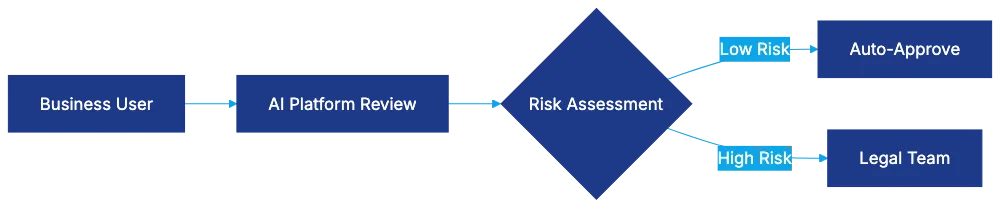
Wordsmith Legal’s platform uses multiple specialized LLM agents instead of a single model, a strategy that aligns with best practices in AI contract analysis. One agent identifies liability provisions, another examines termination clauses, and a third assesses data privacy commitments. This mimics how legal teams operate, enhancing contract analysis accuracy. Each LLM specializes in specific contract elements, improving accuracy and customization. When errors or oversights occur, issues can be traced to specific agents without retraining the entire system. This modularity eases maintenance and adaptability.
Legal Guardrails That Actually Work
Multi-LLM Agent Architecture:
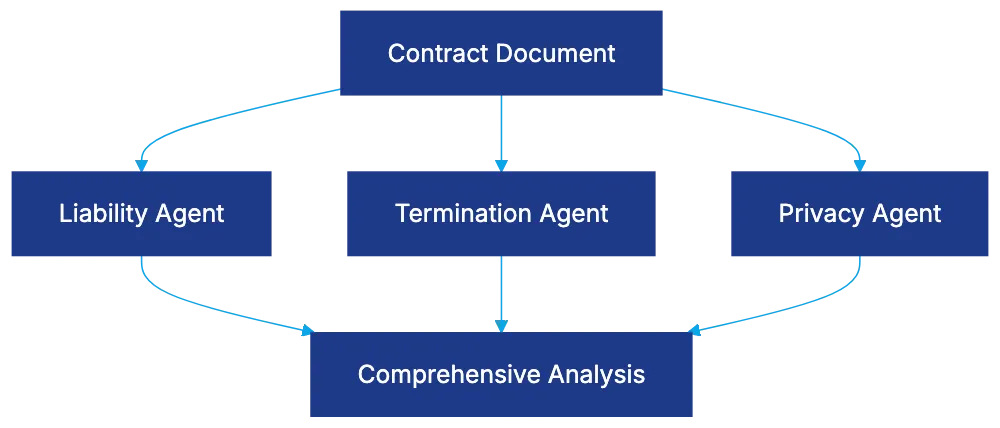
Business self-serve legal can pose risks if contracts aren’t appropriately reviewed. Wordsmith Legal mitigates these with legal guardrails, determining which contracts require legal review. The platform uses risk scoring to categorize contracts as low, medium, or high risk, influenced by contract value, liability caps, indemnification provisions, etc., a method supported by research on AI-driven risk assessment in legal contracts. The guardrails are tailored to your company’s risk tolerance, enforcing standards. The transparency of these guardrails educates business users on contract risks.
Enabling Business Self-Serve Without Losing Control
Risk-Based Contract Routing:
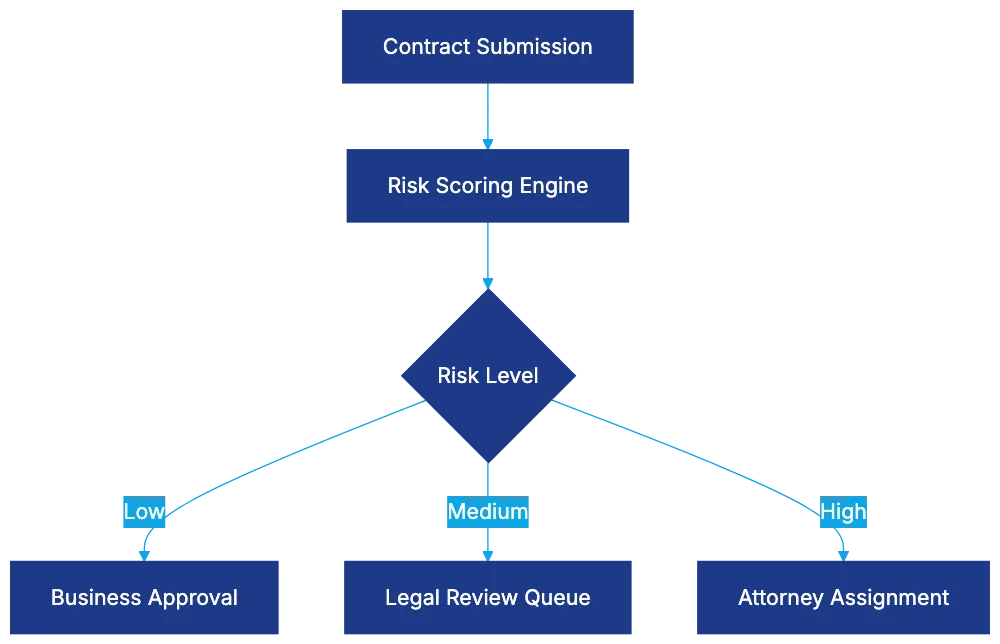
The business self-serve model shifts the role of in-house legal teams to contract governors. Legal teams define rules for contract approval, with the platform enforcing them. Control over legal risk is maintained through guardrails and monitoring. Analytics reveal auto-approved contracts and areas requiring additional business training. For business users, self-serve access reduces deal cycle times and frustration. For example, a sales team member can process an NDA quickly if it meets company standards, accelerating contract processing.
Contract Review Features That Address Real Legal Work
Wordsmith Legal’s feature set optimizes in-house legal tasks. It automates contract tasks beyond redlining, comparing against company playbooks, identifying missing terms, and flagging problematic language. Approval workflows align with organizational structure and risk tolerance. Risk scoring standardizes contract evaluation. Playbook automation encodes standards and preferred language, reducing portfolio variation and time spent on negotiations.
Use Cases Where the Platform Delivers Clear Value
Routine contract approval benefits from Wordsmith Legal’s platform, with NDAs and simple vendor agreements processed swiftly. NDA processing is efficient as the platform automatically sorts them for legal review based on company standards. Vendor agreement standardization ensures contracts meet minimum standards, reducing risks from overlooked provisions. Contract portfolio analysis identifies problematic provisions and refines negotiation strategies.
Integration Capabilities With Existing Legal Systems
Wordsmith Legal integrates with existing contract lifecycle management (CLM) systems and document management platforms, ensuring seamless workflow integration as recommended by ISO standards for contract management. CLM integration ensures smooth contract workflow, maintaining synchronized data. Document management integration accesses existing repositories and templates. The platform fits into existing workflows, enhancing them with AI capabilities and business self-serve access.
The Pricing Model and Implementation Considerations
Wordsmith Legal’s per-seat SaaS subscription model offers predictable costs aligned with usage. Legal teams pay based on user access, simplifying budgeting without concern for volume fluctuations. Setup involves establishing guardrails, defining playbooks, and configuring workflows, encouraging valuable contract risk discussions. Change management is crucial, ensuring business users adapt to self-serve approvals and legal teams manage risk through guardrails. Executives need to understand the evolving role of legal teams.
Bottom Line
Wordsmith Legal helps in-house legal departments focus on complex matters by automating routine contract tasks. The multi-LLM agent architecture enhances AI contract review, while legal guardrails maintain control. Features tailored to in-house operations and existing stack integration highlight the platform’s role. For legal operations seeking efficiency without increasing headcount, the business self-serve model with legal guardrails is a practical solution. The per-seat SaaS pricing model ensures predictable costs, though setup and change management are vital. AI and business users handling routine contracts allow attorneys to focus on complex work.
- What Wordsmith Legal Brings to In-House Legal Teams
- The Multi-LLM Architecture Behind Contract Analysis
- Legal Guardrails That Actually Work
- Enabling Business Self-Serve Without Losing Control
- Contract Review Features That Address Real Legal Work
- Use Cases Where the Platform Delivers Clear Value
- Integration Capabilities With Existing Legal Systems
- The Pricing Model and Implementation Considerations
- Bottom Line