Introduction
In the UK legal market, many AI tools claim to revolutionize AI contract review, yet they often rely on lawyers. Robin AI, a London-based company founded in 2019 by ex-Clifford Chance lawyer Richard Robinson, offers a unique alternative. They combine contract automation with a hybrid legal services model, employing 30-45 in-house lawyers for hands-on legal work. Backed by $68.4 million in funding, including a $26 million Series B led by Singapore’s Temasek investment, Robin AI serves clients like Pfizer, GE, KPMG, and UBS. The question is whether this approach resolves existing challenges or merely shifts them.
The Hybrid Model: Software Plus Lawyers
Robin AI integrates legal professionals into its model. Unlike typical legal AI vendors, Robin AI’s team of 30 to 45 lawyers actively engages in contract review and drafting using advanced contract review software.
Robin AI Service Model:
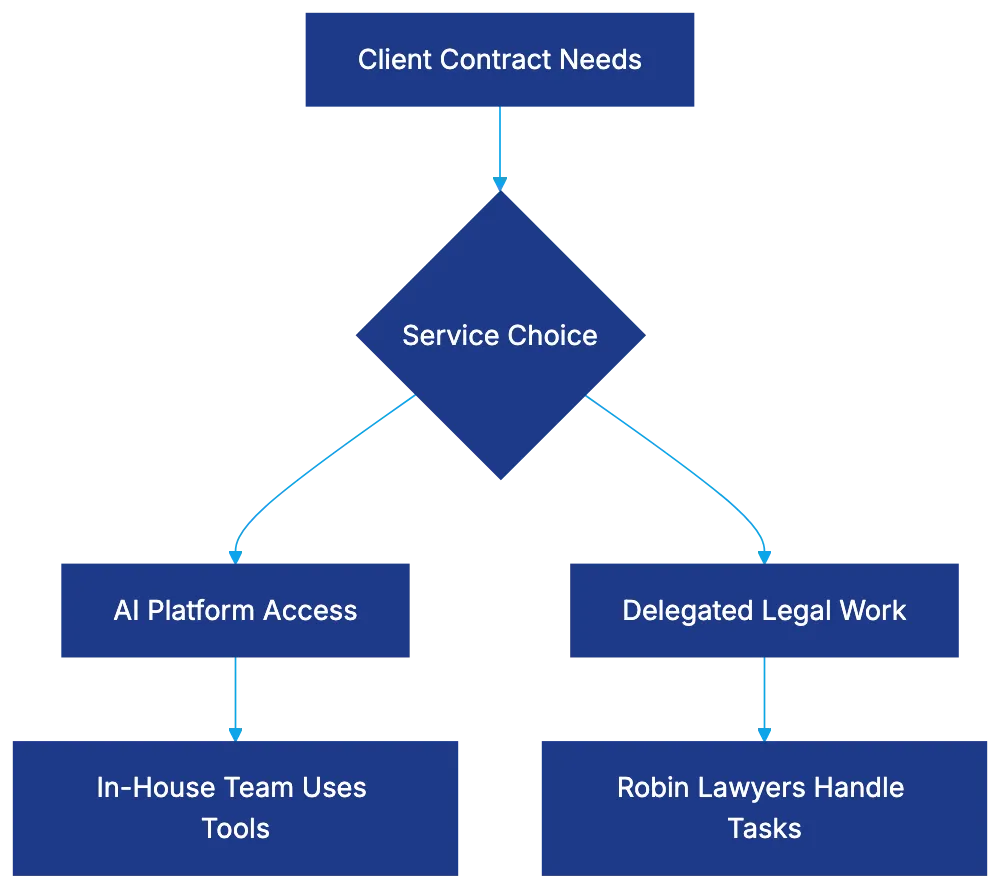
Clients receive access to the AI platform with the option for Robin’s legal team to manage tasks. For routine agreements, clients can delegate to the legal AI UK armed lawyers, utilizing AI tools for efficiency. For complex matters, in-house teams use AI tools, with Robin’s lawyers ready for assistance.
This model acknowledges enterprise contract AI needs skilled legal judgment. By embedding a service layer, Robin AI offers a solution matching legal work realities. Law firms and corporate departments need more than better tools, they need capacity, sometimes necessitating human expertise.
Robin AI’s approach enables higher service fees as they deliver completed work products, not just software licenses. Their lawyers boost throughput via efficient AI contract review, letting clients choose between software usage or outsourcing work based on their bandwidth.
Technology Foundation: Anthropic Claude Partnership
Robin AI’s platform is built on Anthropic’s Claude large language model. The partnership extends beyond API access; it involves training on data from 4.5 million legal documents and over 100 million clauses.
Focus is on specific contract tasks like first-pass review, clause extraction, risk flagging, and suggested edits, with Robin’s lawyers refining AI outputs. The system’s ability to process extensive text maintains context, crucial for efficient contract analysis.
In enterprise contract AI, security is paramount. Robin AI’s ISO 27001 and SOC 2 certifications ensure secure processing without client data feeding public models, addressing significant legal AI tool concerns.
Technology Stack Architecture:

Funding Trajectory and Investor Confidence
Robin AI’s funding highlights investor belief in its hybrid legal services model. Their $68.4 million raised, with Temasek leading the 2023 Series B, signals confidence. Temasek’s involvement indicates Robin AI’s potential to capture significant market share.
Post-Series B, a Series B+ round added $25 million, highlighting sustained momentum in a cooling legal tech funding environment. Investments target expanding the lawyer team, improving AI models, and facilitating geographic growth to meet global client needs.
Investors value Robin AI’s hybrid model for its dual revenue streams from software subscriptions and professional services, proving resilient against pure SaaS models.
Pricing Structure: From Free Tier to Enterprise
Robin AI employs a tiered pricing model. Aimed at SMEs, the free tier offers basic legal AI UK contract review for up to five contracts monthly, fostering client acquisition and gathering user feedback.
Enterprise plans range from $30,000 to $100,000+ annually, factoring in contract volume and complexity. By bundling lawyer time with software access, Robin AI ensures predictability.
The value of Robin AI’s hybrid services is evident in time savings and ROI at scale, particularly for high-frequency, high-complexity contract reviews.
Enterprise Adoption: Notable Client Base
Robin AI’s client roster, featuring GE, Pfizer, KPMG, and UBS, underscores their platform’s readiness for large-scale, mission-critical legal work. Pfizer’s complex contract needs, KPMG’s volume-driven requirements, UBS’s compliance focus, and GE’s diverse operational demands demonstrate Robin AI’s capability to handle sophisticated contracts.
These implementations signify meaningful enterprise adoption, positioning Robin AI as a credible legal AI solution provider.
Contract Review Workflow:

Practical Use Cases Across Contract Lifecycle
Robin AI excels in practical applications of AI contract review. Legal teams use the platform for first-pass analysis, benefiting from time reductions and seamless playbook enforcement.
The platform’s role in first-pass drafting supports business needs for rapid contract generation. Robin AI’s automated consistency checks prevent deviations from approved standards, shifting focus to proactive governance.
Vendor agreement management and contract migration are other advantages, with Robin AI standardizing legacy agreements and managing high volumes while maintaining quality.
Challenges and Limitations Worth Considering
Robin AI’s model introduces challenges not faced by pure software vendors. Dependencies on their legal team may create bottlenecks, necessitating careful scaling and management.
The AI’s reliance on pattern recognition limits its analytical capacity for novel provisions, requiring human judgment for nuanced decision-making. Continuous retraining is vital.
The free tier’s appeal to small businesses necessitates caution; Robin AI must clearly communicate limitations to prevent over-reliance on AI analysis alone.
The UK Legal AI Landscape and Robin’s Position
Situated at the forefront of the UK legal AI landscape, Robin AI benefits from a sophisticated legal market, strong AI research, and a supportive regulatory framework.
Robin AI’s contract-focused model and hybrid services provide differentiation in a crowded legal AI UK market. By integrating technology with practical implementation, they’ve proven appealing to enterprise clients.
Legal education and the UK’s AI governance framework further bolster their position, enhancing adoption and facilitating European expansion.
Bottom Line
Robin AI’s hybrid model redefines AI contract review by blending contract automation with legal services. Their strategic funding, enterprise adoption, and partnership with Anthropic Claude signal a robust approach aligned with market needs for legal AI.
By addressing both technological and service gaps, Robin AI stands as a viable contender within the broader legal AI industry, offering a comprehensive solution for contract automation challenges.
- Introduction
- The Hybrid Model: Software Plus Lawyers
- Technology Foundation: Anthropic Claude Partnership
- Funding Trajectory and Investor Confidence
- Pricing Structure: From Free Tier to Enterprise
- Enterprise Adoption: Notable Client Base
- Practical Use Cases Across Contract Lifecycle
- Challenges and Limitations Worth Considering
- The UK Legal AI Landscape and Robin's Position
- Bottom Line