Introduction
Contract analysis AI has revolutionized M&A due diligence and legal document review. Before tools like Kira Systems emerged in 2010, associates manually reviewed contracts for weeks. Kira’s machine learning technology automated this, reducing review time from weeks to days. Acquired by Litera in August 2021, Kira retains a dominant market share, with 64% of Am Law 100 firms using it, processing over 450,000 documents monthly. This article examines Kira’s functionality, its evolution under Litera, and its suitability for complex contract review projects.
The Origin Story and Litera Acquisition
Kira Systems was founded in 2010 by Noah Waisberg and Alexander Hudek in Toronto. Waisberg, a corporate lawyer, identified machine learning as a solution for M&A contract review. Hudek, with technical expertise, helped develop the platform.
Acquired by Litera in August 2021, Kira was estimated to be worth hundreds of millions. At acquisition, Kira had 84% of the top 25 M&A firms globally and strong ties with corporate legal departments. Litera’s acquisition aimed to build a comprehensive legal workflow, integrating Kira into its existing technologies.
How Machine Learning Powers Provision Extraction
Kira’s Machine Learning Architecture:
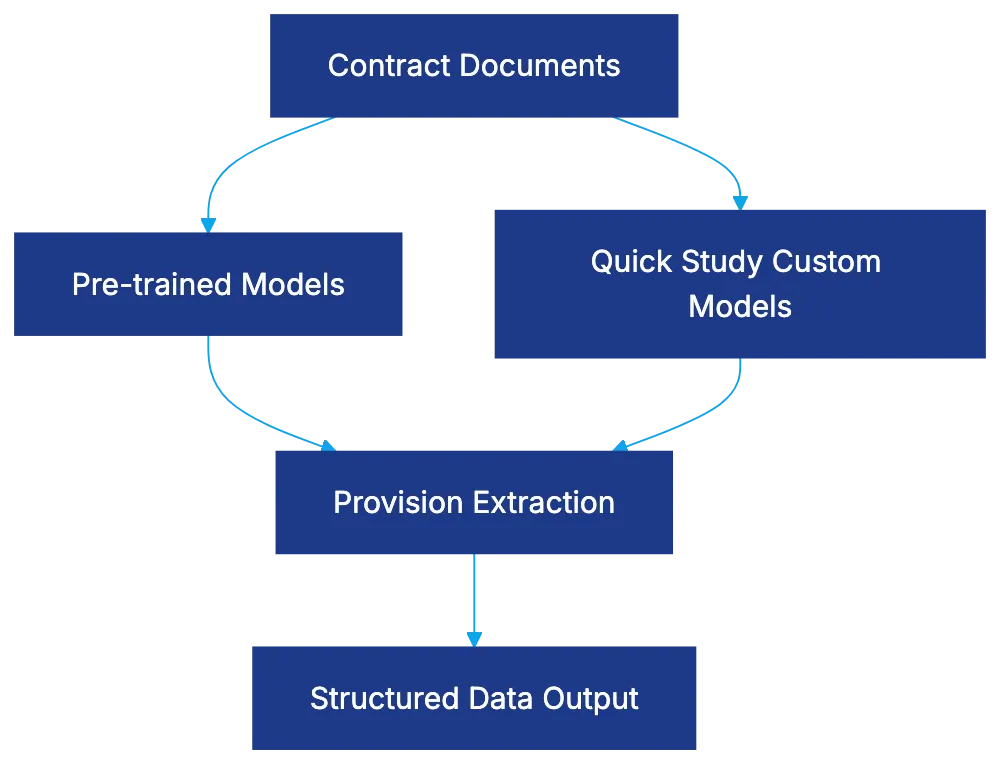
Kira’s AI uses supervised learning with over 1,400 pre-trained models covering 40+ legal areas, identifying specific clauses like indemnification and termination rights. Kira’s 95-97% accuracy reduces the need for extensive document reading by focusing reviewers on relevant provisions. It supports 100+ languages, though accuracy varies. English contracts perform best.
Quick Study: Training Custom Models Without Coding
Kira’s Quick Study lets legal professionals train custom models without coding. By highlighting 10-30 examples, a lawyer can teach Kira to identify similar clauses. For a pharmaceutical M&A transaction, an associate can train a model on 15 contracts and apply it to 300 others. Success depends on data quality and example clarity.
Quick Study Training Process:

Combining Within the Litera Ecosystem
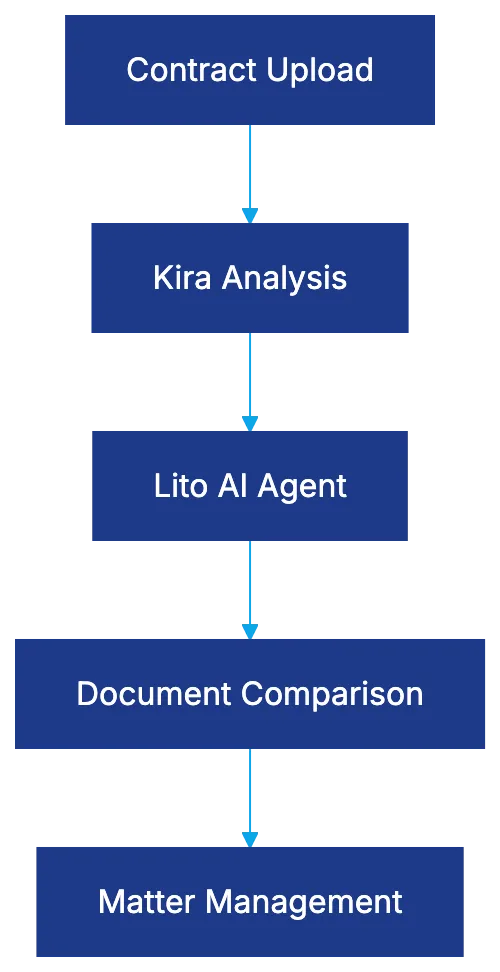
Kira’s integration into Litera’s platform creates seamless data flow, combining with “Lito,” Litera’s AI Legal Agent launched in 2024, for tasks like summarization and clause comparison. Lito adds understanding of provision meanings and comparisons, enhancing workflow efficiency.
Litera also integrated Kira with document comparison, redlining, and matter management tools, allowing seamless transitions in contract lifecycle. Litera spun off Zuva to commercialize Kira’s AI for broader applications.
Litera Ecosystem Integration:
Market Dominance in Am Law 100 and M&A Firms
Kira’s 64% adoption in Am Law 100 firms and 84% in the top 25 M&A firms reflects its dominance. M&A firms, handling large transactions, benefit greatly from due diligence automation. Kira’s large-scale use allows it to identify performance issues rarely seen by smaller competitors. Its pricing targets enterprise customers, with alternatives for those with limited budgets.
Real-World Applications Beyond M&A Due Diligence
While M&A due diligence is a core use, Kira is used for lease abstraction and contract migration, enabling faster data processing for tasks requiring high precision. Regulatory compliance reviews and knowledge management also benefit from Kira’s capabilities, adapting to various practice areas.
Enterprise Pricing and Value Calculation
Kira offers enterprise-focused pricing via custom quotes, frustrating some clients with lack of transparent costs. The value is seen by comparing potential manual review costs against Kira’s subscription fees, but consideration of factors like utilization rates and training is necessary.
Competitive Position and Alternative Platforms
Kira’s competitors like LawGeex, eBrevia, and ThoughtRiver offer varied pricing or focus on specific applications. Kira excels in M&A, but diverse requirements mean different AI platforms may better suit other needs.
Implementation Challenges Legal Teams Face
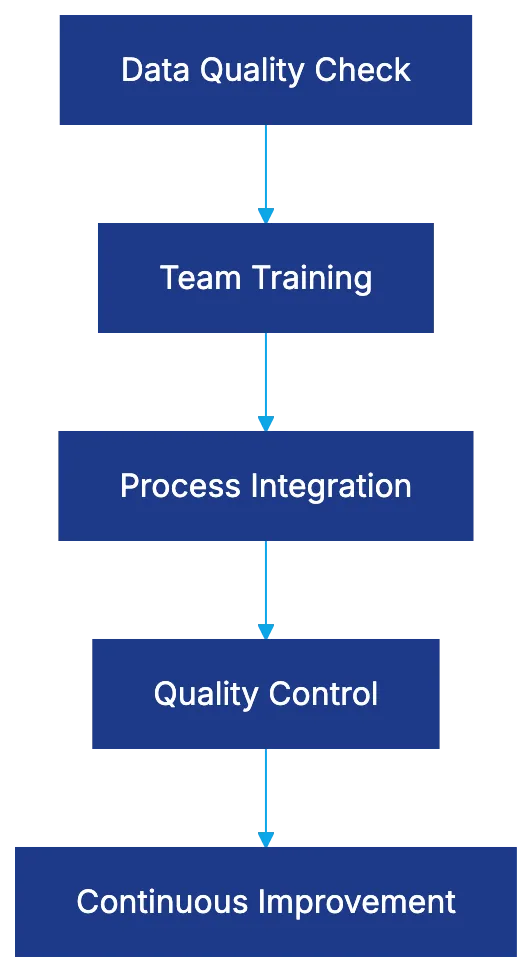
Contract analysis AI implementation involves data quality issues, change management, training investments, and quality control processes. Issues like format inconsistencies and scan quality affect performance. Change management resistance, coupled with training and quality control needs, can hinder efficiency gains.
Implementation Workflow:
Technical Limitations Worth Understanding
Contract analysis AI has context limitations. While Kira identifies location, it struggles with nuanced interpretation. Negative provisions, amended agreements, and multi-document obligations present challenges needing human oversight.
The Bottom Line
Kira Systems established itself as essential in M&A technology, offering vast model libraries, Quick Study, and Litera integration. It provides great value for large volume reviews, processing 450,000 documents monthly. Despite costs and setup demands, Kira’s market presence in M&A remains unrivaled. Smaller firms, or those focused on other applications, might find more suitable solutions in the expanding legal AI tool landscape. Firms must assess whether Kira aligns with their needs and resources.
- Introduction
- The Origin Story and Litera Acquisition
- How Machine Learning Powers Provision Extraction
- Quick Study: Training Custom Models Without Coding
- Combining Within the Litera Ecosystem
- Market Dominance in Am Law 100 and M&A Firms
- Real-World Applications Beyond M&A Due Diligence
- Enterprise Pricing and Value Calculation
- Competitive Position and Alternative Platforms
- Implementation Challenges Legal Teams Face
- Technical Limitations Worth Understanding
- The Bottom Line