What Dioptra AI Brings to AI Contract Review
AI contract review, traditionally laborious, can keep lawyers busy for hours. Dioptra AI, a Y Combinator company from the Winter 2022 batch, aims to speed up contract review by using multiple AI models. In November 2025, Icertis acquired Dioptra. Dioptra’s website still offers demos and sign-ups.
In-house legal teams facing hefty contract volumes find Dioptra an efficient tool. The platform is ideal for SaaS firms and startups, where contract numbers increase more rapidly than staffing, creating bottlenecks and client frustration, a common challenge in growing in-house legal teams.
The Technology Behind Multi-LLM Orchestration
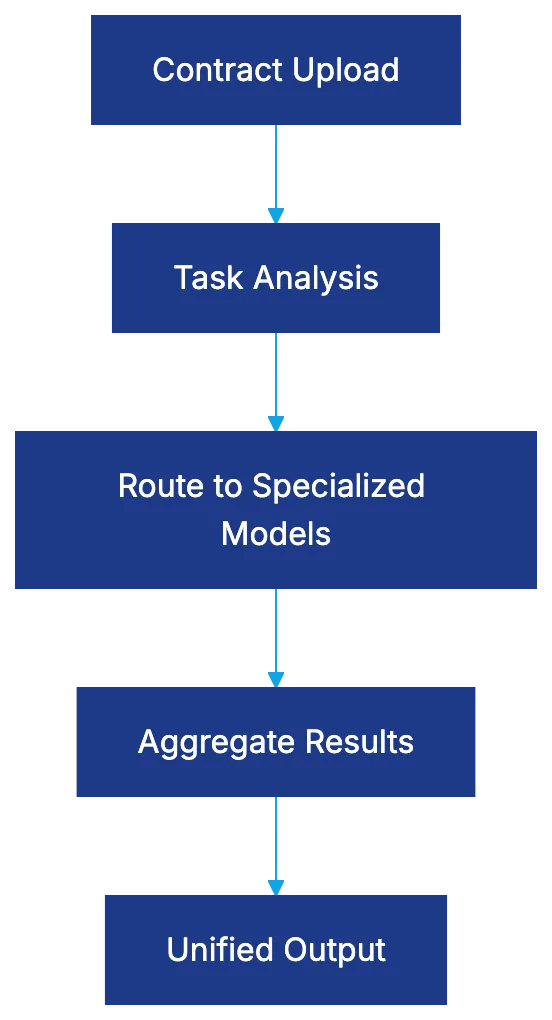
Most legal AI platforms use a single language model. Dioptra’s multi-LLM orchestration employs multiple models concurrently to enhance strengths while reducing individual model deficits. By directing tasks to the most suitable models (for example, using Claude for indemnification and GPT-4 for liability caps) Dioptra optimizes performance without user intervention.
Multi-LLM Orchestration Approach:
Dioptra’s website reports 95% accuracy on a company’s own contract paper and 92% on counterparty paper. These are the vendor’s own figures, so lawyers should still review every suggested redline.
Target Market and User Profile
Dioptra targets SaaS firms and in-house legal teams in startups, not designed for Big Law or complex M&A tasks. The platform suits companies handling numerous similar contracts like customer agreements or NDAs. Typical users are Series B SaaS firms with minimal legal staffing, confronting a surge in monthly deals needing review, redlining, and negotiations.
In-house teams benefit most, as law firms can absorb extra contract review through billable hours, whereas in-house teams require efficiency multipliers. Pricing caters to early-stage teams, promoting time savings over costly enterprise software.
Core Features and Functionality
Dioptra automates contract upload and clause extraction, identifying key contract features in seconds. Risk identification highlights problem provisions based on tailored playbooks. Dioptra suggests redrafts, helping lawyers save drafting time. Clause extraction offers a structured contract provision database, facilitating reporting and ensuring deal consistency.
Wilson Sonsini’s Use of Dioptra
Automated Contract Review Workflow:

In May 2024, Wilson Sonsini’s Neuron group launched a fixed-fee contract review offering for cloud services agreements built with Dioptra, Artificial Lawyer reported. The report gives only Dioptra’s own accuracy figure and does not describe a benchmark run by the firm.
Practical Use Cases for In-House Teams
SaaS contract review is Dioptra’s core use. The platform expedites contract processing and deviation flagging. Vendor agreements present different challenges, with Dioptra highlighting unacceptable terms, aiding negotiation focus. Complex partnership agreements still benefit from AI for preliminary review, expediting human-led strategy and negotiation.
NDA review, common in growth phases, benefits as Dioptra swiftly confirms standard terms, saving significant time across agreements.
Competitive Positioning in Legal Tech
The AI contract review sector is saturated. Dioptra stands out with its multi-LLM approach and startup-friendly pricing. Traditional enterprise platforms offer comprehensive lifecycle management, but Dioptra prioritizes accuracy and speed. Icertis says Dioptra’s redlining and automated playbook creation now also add to the Icertis Contract Intelligence platform.
Dioptra avoids hefty enterprise costs, focusing on smaller firms with limited legal teams.
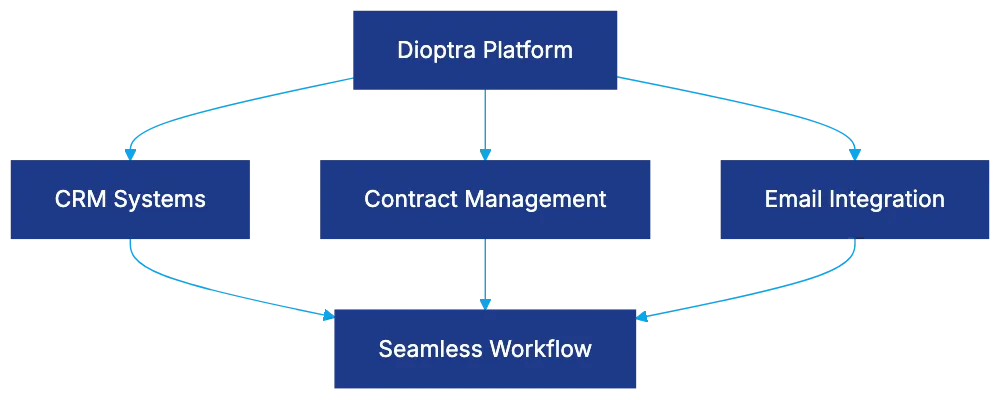
System Integration Architecture:
Integration with Systems and Workflows
Dioptra integrates with systems like Salesforce, ensuring contracts are reviewed smoothly within existing workflows, as detailed in Dioptra’s integration capabilities. Integration with CRM and contract management platforms ensures Dioptra’s capabilities are seamlessly deployed. Email integration addresses the common use case of email contract submissions.
This system understanding means lawyers use fewer systems, increasing tool adoption. Effective integrations prevent isolation from existing legal practices.
Implementation Considerations and Best Practices
AI contract review entails more than software licensing. Customize playbooks for risk tolerance and positions. Team training balances trust in AI outputs with necessary scrutiny. Final human oversight remains essential.
Documenting AI-assisted reviews ensures responsibility and quality control, providing a defensible position on contract term acceptance.
Bottom Line
Dioptra AI tackles a real need for growing in-house teams. The multi-LLM approach offers genuine utility without the complexity and cost of larger systems. While not replacing legal expertise, it offloads routine tasks, allowing lawyers to tackle complex issues strategically.
For teams managing substantial, repetitive contracts, Dioptra delivers clear ROI. Unique, complex deals make less ideal use of the platform. Dioptra is now part of Icertis, so ask how the product and its pricing will change before you sign a long contract.
- What Dioptra AI Brings to AI Contract Review
- The Technology Behind Multi-LLM Orchestration
- Target Market and User Profile
- Core Features and Functionality
- Wilson Sonsini's Use of Dioptra
- Practical Use Cases for In-House Teams
- Competitive Positioning in Legal Tech
- Integration with Systems and Workflows
- Implementation Considerations and Best Practices
- Bottom Line