
Ultimate Guide to Legal AI Tools for Law Firms in 2026
Introduction
Legal AI Tool Categories:

Legal AI tools have evolved into essential practice infrastructure. The 2023 ABA Legal Technology Resource Center survey indicates 73% of law firms now use AI-powered legal software, up from 35% in 2020. This shift improves practice by reducing contract review times, uncovering relevant case law, and recovering lost billable time. This guide highlights five major categories of legal technology tools.
Contract Review and Analysis Tools
Contract review AI is a mature application in legal technology. These platforms use machine learning to understand contract structure, identify harmful clauses, and enforce playbooks. A playbook enforces a firm’s preferred contract positions. AI compares clauses against these preferences, detecting issues beyond keyword searches. Advanced systems identify missing provisions, ambiguities, and inconsistencies. Automated redlining proposes edits for negotiation compliance, accelerating the process.
Platform differentiation is significant. Kira Systems leads with a comprehensive library and quick custom model training. Luminance employs a Legal-Grade LLM, offering multilingual analysis. Harvey uses Claude models with a Trust Stack architecture for confidentiality. LegalOn provides rapid deployment with pre-built playbooks, reducing setup time.
Pricing ranges from $15,000 to over $300,000 annually, based on user count and customization.
Contract Review AI Workflow:

Legal Research Tools
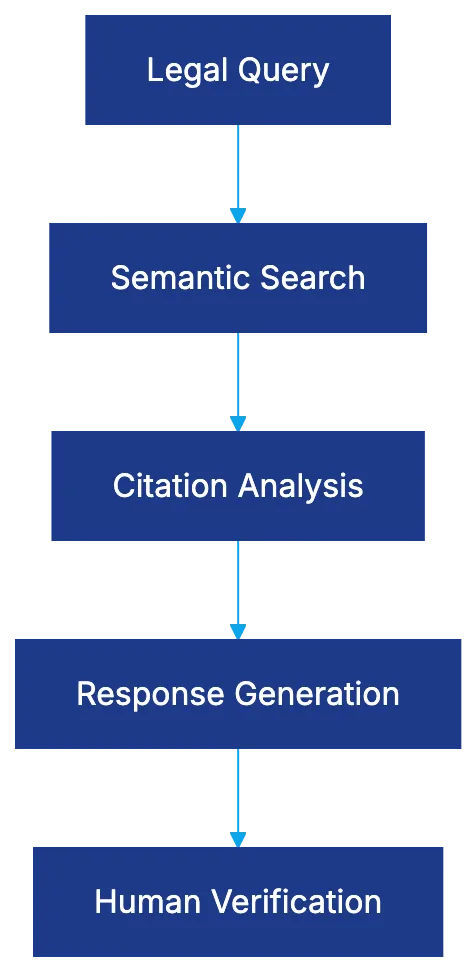
Legal research AI transforms attorney workflows through semantic search and citation network analysis. Semantic search captures the context of queries, enhancing relevance over keyword matches. Relevant authority often appears as a subtle semantic connection, not shared keywords.
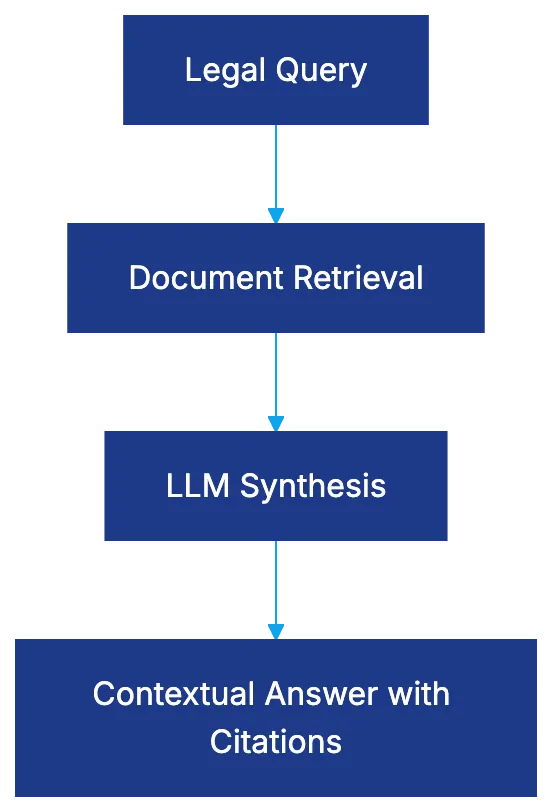
RAG architecture represents the state of the art, combining document retrieval with LLMs for synthesized answers. This reduces hallucination risk, which is common with standalone LLMs.
Leading platforms include Westlaw Precision, Lexis+ AI, CoCounsel, and vLex’s Vincent AI. CoCounsel exemplifies practical use by drafting memos with relevant citations. Individual subscriptions range from $300 to $500 monthly, with firm-wide implementations causing higher costs.
RAG Architecture for Legal Research:
E-Discovery and Document Review
E-discovery AI addresses massive document review in litigation. The Electronic Discovery Reference Model outlines nine stages of e-discovery. AI focuses on the review and analysis stages, with TAR and CAL representing key applications. TAR 2.0 and CAL refine predictions in real-time, achieving higher recall with less attorney review.
Studies show TAR surpasses manual review, finding more relevant documents efficiently. Relativity, Everlaw, Reveal, and Logikcull lead in the e-discovery field. Pricing follows a per-gigabyte model, with large cases exceeding seven figures.

Practice Management and Efficiency Tools
Practice management AI streamlines administrative challenges, including trust accounting and time tracking. Automated reconciliation reports ensure compliance, while AI-powered time tracking recovers billable time lost in daily activities.
Leading platforms include Clio, MyCase, PracticePanther, and Thomson Reuters Elite 3E. Security is essential, with SOC 2 Type II certification, AES-256 encryption, and TLS 1.3 standards. Pricing ranges from $39 to $129 per user monthly, with enterprise solutions exceeding $100,000 annually.
Document Automation and Assembly
Document automation AI generates legal documents using conditional logic. It ensures consistent clause integration across scenarios, enhancing firm efficiency. Docassemble offers powerful open-source software, while commercial platforms like HotDocs, Contract Express, and XpressDox provide user-friendly alternatives.
The effectiveness of document automation scales with volume, saving significant attorney hours. Security parallels practice management considerations, ensuring confidentiality.
Selection Criteria and Implementation Considerations
Choosing legal AI tools involves matching capabilities to firm needs based on size, practice area, and security. Solo practitioners need affordable tools, while large firms seek customized solutions. Security compliance varies, with SOC 2 Type II, AES-256, and TLS 1.3 standards being critical.
Integration with existing systems is vital to prevent disconnected silos. Effective training and usability drive adoption, with total annual costs between $5,000 and over $500,000 depending on firm size.
Risk Management and Ethical Considerations
AI tools require understanding competence, confidentiality, and supervision responsibilities. Attorneys must comprehend AI limitations and ensure client data confidentiality. Model Rule 1.1 emphasizes keeping abreast of technology benefits and risks. Bias and retention policies necessitate vigilance and testing to maintain ethical standards.
End
Legal AI tools have advanced beyond experimentation, becoming integral to successful legal practices by improving efficiency in contract review, research, document handling, and management tasks. Selecting the right tools enhances profitability and client service.
Frequently Asked Questions
What factors should I consider when selecting a legal AI tool?
When selecting a legal AI tool, assess your firm's size, specific practice area, security requirements, and the overall compatibility with existing systems. Consider the necessary features and how they align with your firm's workflow to ensure a seamless integration and enhanced efficiency.
How do AI contract review tools improve efficiency?
AI contract review tools enhance efficiency by automating the identification of harmful clauses, missing provisions, and ambiguities in contracts. They use advanced machine learning algorithms to quickly compare contract clauses against a firm's preferred positions, significantly reducing the time required for manual review.
What is the pricing range for e-discovery AI tools?
E-discovery AI tools typically follow a per-gigabyte pricing model, with costs varying based on the volume of documents. For larger litigation cases, expenses can exceed seven figures due to the extensive amount of data needing review and analysis.
How can legal research AI tools help me?
Legal research AI tools facilitate faster and more relevant search results through semantic search and citation analysis. They enhance the attorney's ability to find pertinent case law and legal precedents, streamlining the research process and improving the quality of legal memoranda and opinions.
What are some common ethical considerations when using AI in law?
Ethical considerations include maintaining client confidentiality, ensuring the accuracy of AI-generated outputs, and understanding the limitations of AI tools. Lawyers are responsible for supervising AI use and must remain vigilant against bias and data retention issues to uphold ethical standards.
How does document automation benefit law firms?
Document automation saves law firms significant attorney hours by generating legal documents using conditional logic and templates. This ensures consistency, reduces the risk of errors, and allows attorneys to focus on higher-value tasks while enhancing overall firm efficiency.
What training is necessary for effective use of legal AI tools?
Effective training should cover the functionalities of the AI tools, best practices for implementation, and ongoing support for users. Ensuring that staff is adequately trained is crucial for maximizing the tool's benefits and achieving higher adoption rates within the firm.
Related Articles
AI Legal Research: Transforming the Legal Industry
Explore how AI legal research tools are revolutionizing the legal field with enhanced accuracy and efficiency.

12 Best AI Tools for Lawyers in 2026
Discover the top AI software for attorneys in 2026. Expert reviews of legal AI tools covering research, drafting, e-discovery, and practice management.

12 Best AI Contract Review Software in 2026
Compare the top AI contract review tools for law firms. Expert analysis of features, pricing, and performance to help you choose the right solution.