
Harvey AI Review: Advanced Legal AI for Law Firms
Introduction
Harvey AI is tailored for law firms seeking AI assistance beyond a basic chat interface. Harvey collaborates with OpenAI to build custom legal AI models, trained on billions of legal tokens, preferred by lawyers over standard AI models. It targets major law firms with enterprise pricing and setup. This review covers the technical architecture, performance metrics, use cases, and enterprise value, aiding firms comparing Harvey to competitors.
Technical Architecture and OpenAI Partnership
Harvey is more than just an API wrapper; it collaborates with OpenAI to develop models for legal use. These foundation models, trained on over 10 billion tokens of US case law, understand legal reasoning, citation, and jurisdictional details. Harvey uses a cascading system with Retrieval-Augmented Generation to ground responses in reliable legal databases and firm-specific documents, addressing AI hallucination issues.
Harvey AI Technical Architecture:
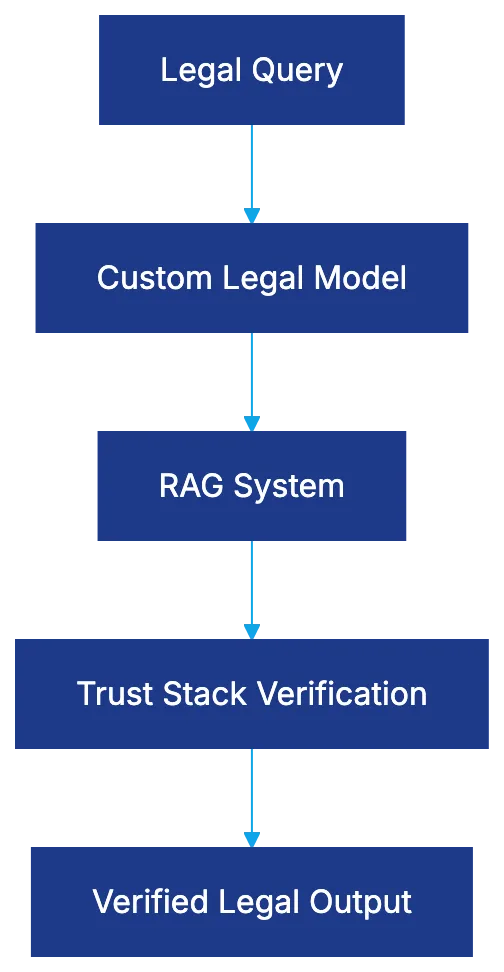
Harvey’s Trust Stack ensures accuracy by verifying and cross-referencing citations, vital where errors can harm client relationships. The platform customizes outputs using a firm’s proprietary documents, distinguishing it from consumer tools.
BigLaw Bench Performance Results
Harvey’s performance was evaluated through BigLaw Bench, comparing its specialized model with GPT-4. Results showed 97% of lawyers preferred Harvey for case law analysis, highlighting significant improvements due to legal-specific training. Lawyers preferred Harvey’s outputs for practical tasks such as identifying precedents and synthesizing case holdings, indicating its value.
While Harvey’s superior performance is noted, it still requires lawyer oversight. Current AI systems, including Harvey, cannot yet produce unsupervised legal work.
Core Use Cases and Applications
Legal AI Workflow Process:

Harvey aids in legal research, generating memos with citations and identifying authority. It also assists in contract drafting and review by analyzing agreements and suggesting alternatives. For large-scale document analysis, Harvey handles initial reviews, saving associate time. In litigation, Harvey supports deposition and discovery preparations, while transactional groups use it for due diligence checklists and closing documents.
Enterprise-Only Pricing and Implementation
Harvey targets enterprise clients with custom pricing based on firm size and needs, excluding smaller firms. Setup involves extensive integration and customization over months with ongoing support and updates, reducing deployment risk for major firms. This model suits large firms by justifying investment through displacement of associate time.
Security, Data Privacy, and Ethical Compliance
Harvey ensures enterprise-grade security, maintaining SOC 2 compliance and meeting law firm standards. Client data remains isolated, addressing ethical concerns on AI training. Firms control data retention and deletion, complying with client demands. ABA Model Rules for competence and supervision apply; Harvey generates work requiring attorney review.
Privilege is protected as Harvey acts under attorney direction. Firms should ensure privilege considerations align with AI use.
Comparison to Alternative Legal AI Platforms
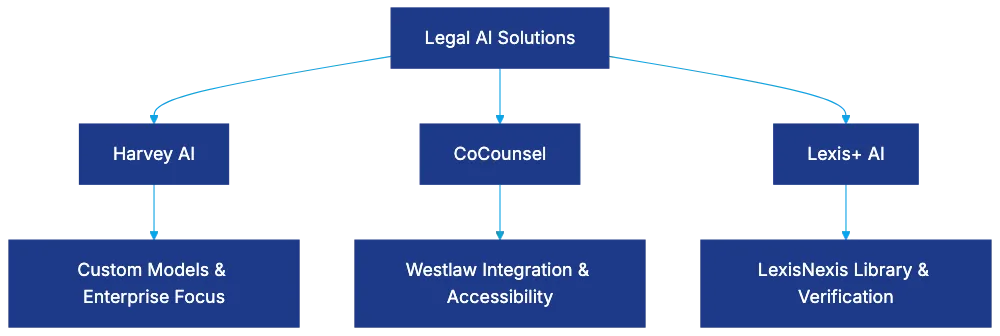
CoCounsel by Thomson Reuters, using OpenAI foundations like Harvey, supports Westlaw integration, offering broader accessibility but less customization. Lexis+ AI grounds its outputs in LexisNexis’s legal library, providing verified material but less firm-specific adaptability. General tools like ChatGPT lack Harvey’s specialization and accuracy.
Harvey focuses on firm-specific customization and enterprise clients, while alternatives offer broader, less tailored access.
Legal AI Platform Comparison:
Limitations and Considerations
Harvey’s enterprise model excludes small and solo firms, concentrating AI advantages in large firms. Despite high performance, oversight is needed, complying with legal responsibility rules. Setup complexity requires months of effort with change management. Practices must align use cases with Harvey’s capabilities for ROI.
International and niche legal areas may find Harvey’s training less comprehensive, with expansion in progress. Vendor dependency requires risk evaluation and contingency planning.
Bottom Line
Harvey AI is tailored for large firms, offering custom models and verifications, outperforming general AI. It suits high-volume, document-intensive firms benefiting from substantial AI investment. Enterprise pricing and setup limit access to major firms, requiring strategic evaluation of customization versus existing research vendor integration.
Harvey requires attorney oversight, with setup policies ensuring supervision. It offers robust capabilities deserving evaluation against alternatives for firms prepared for AI adoption.
Frequently Asked Questions
What types of law firms should consider using Harvey AI?
Harvey AI is specifically designed for large law firms, particularly those engaged in high-volume and document-intensive work. Its enterprise pricing and extensive customization make it less suitable for smaller or solo firms.
How does Harvey ensure the accuracy of its legal outputs?
Harvey utilizes a Trust Stack that verifies and cross-references citations to enhance accuracy. This system is critical in the legal context, where inaccuracies can lead to significant consequences for clients.
What are the main functionalities of Harvey AI?
Harvey AI excels in legal research, memo generation, contract drafting, and document analysis. It supports lawyers in litigation and due diligence processes, significantly improving efficiency and quality in these tasks.
What is the implementation process for Harvey AI like?
The implementation of Harvey AI requires extensive customization and can take several months. This process includes integration with existing systems and ongoing support, which helps mitigate deployment risks for law firms.
Are there any ethical considerations when using Harvey AI?
Yes, ethical considerations are paramount as Harvey must align with ABA Model Rules regarding legal competency and oversight. Privilege protection is maintained, and firms must ensure AI use complies with relevant legal standards.
How does Harvey AI compare to other legal AI platforms?
Harvey differentiates itself through its focus on firm-specific customization and higher performance compared to general tools like ChatGPT. Alternatives like CoCounsel and Lexis+ AI provide broader access but lack the same level of tailored integration and enterprise features.
What limitations should firms be aware of when considering Harvey AI?
Firms should recognize that Harvey’s enterprise model is not available for smaller practices. Additionally, oversight from qualified attorneys is required, and potential dependency on the vendor should be evaluated in terms of risk and contingency planning.
Related Articles

Guide to Legal Document Automation Software
Explore the top legal document automation tools to enhance efficiency in your firm.

Understanding E-Discovery Software in 2026
Explore how AI-powered e-discovery software transforms legal document review with efficiency and accuracy.

Review of Spellbook AI for Legal Professionals
Explore how Spellbook AI enhances contract drafting and review for legal professionals with Microsoft Word integration.