
Understanding E-Discovery Software in 2026
Table of Contents
- Understanding E-Discovery Software
- The EDRM Framework: Foundation of Modern E-Discovery
- Nine Stages of the EDRM Explained
- The Cost Crisis: Why Review Demands AI Solutions
- Technology Assisted Review: TAR 1.0 Explained
- Continuous Active Learning: TAR 2.0 Revolution
- Court Acceptance: From Skepticism to Black Letter Law
- AI Capabilities Beyond Predictive Coding
- Selecting E-Discovery Software: What to Evaluate
- Implementation Best Practices for Legal Teams
- The Bottom Line
- Understanding E-Discovery Software
- The EDRM Framework: Foundation of Modern E-Discovery
- Nine Stages of the EDRM Explained
- The Cost Crisis: Why Review Demands AI Solutions
- Technology Assisted Review: TAR 1.0 Explained
- Continuous Active Learning: TAR 2.0 Revolution
- Court Acceptance: From Skepticism to Black Letter Law
- AI Capabilities Beyond Predictive Coding
- Selecting E-Discovery Software: What to Evaluate
- Implementation Best Practices for Legal Teams
- The Bottom Line
Understanding E-Discovery Software
The legal industry faces a challenge. In 2023, organizations generated 2.5 quintillion bytes of data daily. When litigation hits, legal teams must sift through this electronically stored information. A single attorney reviews roughly 50 documents per hour, so 500,000 documents require 10,000 billable hours, costing over $3 million. Electronic discovery
E-discovery software changes this with AI-powered tools that use machine learning to identify relevant documents. They reduce review time by 40-60%, cutting costs and improving accuracy. This guide explains how modern e-discovery tools work and why AI-driven methods are standard practice. AI in E-Discovery: Better Document Review and Litigation Support
The EDRM Framework: Foundation of Modern E-Discovery
George Socha Jr. and Tom Gelbmann created the Electronic Discovery Reference Model in 2005 to organize digital discovery. It’s a framework that maps e-discovery work, often cycling back to earlier stages as new info surfaces. EDRM
The EDRM visual features two triangles over nine stages. The Yellow Volume Triangle shows data narrows through stages; the Green Relevance Triangle shows relevant material percentage increases. Grey arrows indicate iteration points.
EDRM Framework Overview:

This framework provides a common language for legal teams, IT professionals, and e-discovery vendors. It’s become the industry standard, cited worldwide. Understanding this model is foundational for e-discovery software users.
Nine Stages of the EDRM Explained
- Information Governance: Involves data policies for retention, classification, and deletion. Strong governance means effective legal holds, reducing unnecessary data costs.
- Identification: Legal teams identify potential electronically stored info sources, including email servers, mobile devices, and social media accounts. Incomplete identification causes future issues.
- Preservation: Legal holds ensure evidence remains intact. Software tracks custodian acknowledgments, sends reminders, and documents preservation for court.
- Collection: Forensically acquires identified data, maintaining metadata and custody documentation. Many software platforms include collection modules.
- Processing: Transforms raw data into reviewable formats including de-duplication and metadata extraction. Modern software automates processing.
The Cost Crisis: Why Review Demands AI Solutions
Review is the most expensive e-discovery stage, consuming 70% of costs. Attorneys review documents for relevance and privilege at $75-300 per hour, inflating costs in large cases.
E-Discovery Review Process:
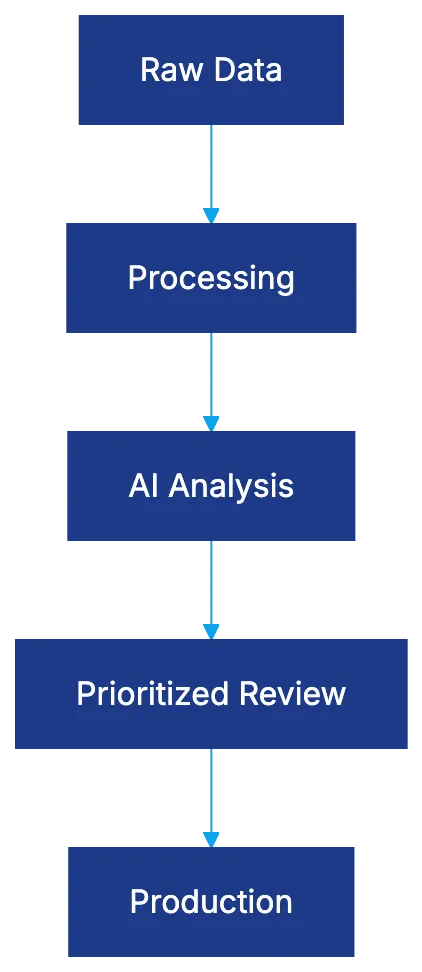
Keyword searches result in low precision and massive irrelevant document volumes. Studies show they often miss 20-30% of relevant documents.
AI e-discovery drastically improves this. Machine learning identifies relevance patterns across documents, emphasizing materials likely relevant, reducing irrelevant document review.
Technology Assisted Review: TAR 1.0 Explained
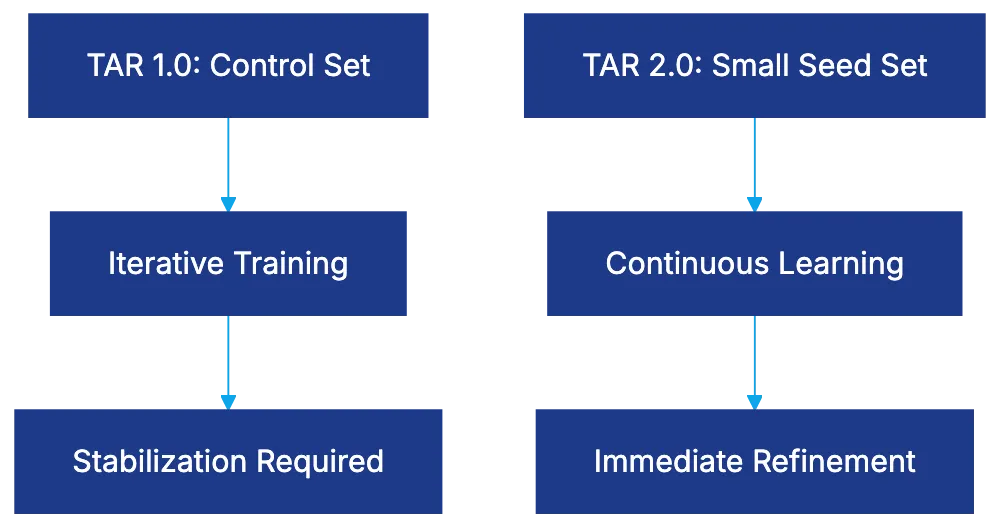
TAR 1.0 uses machine learning for document prioritization based on relevance predictions, starting with a random control set coded for training. This repeats iteratively, stabilizing and then ranking documents for relevance.
Continuous Active Learning: TAR 2.0 Revolution
TAR 2.0, or Continuous Active Learning, is advanced. CAL starts with as few as 50-100 documents, making immediate predictions and refining as coding progresses, cutting review volume by 40-60%.
TAR Evolution Comparison:
Court Acceptance: From Skepticism to Black Letter Law
Judges initially doubted predictive coding. Da Silva Moore v. Publicis Groupe marked its first judicial approval. Now, AI-powered review is considered superior, and ignoring it could mean inefficiency and malpractice.
AI Capabilities Beyond Predictive Coding
Modern software includes:
- Email Threading: Identifies email chains, reducing redundant copies by 20-35%.
- Near-Duplicate Detection: Finds similar but not identical documents.
- Concept Clustering: Groups documents by similarity, highlighting collection themes.
- Privilege Detection: Identifies potentially privileged documents.
- Communication Mapping: Visualizes relationships and information flow.
Selecting E-Discovery Software: What to Evaluate
The e-discovery market includes many vendors. Key areas to evaluate:
- Processing Capabilities
- Review Interface Quality
- AI and Analytics Features
- Production Capabilities
- Security and Compliance
- Vendor Support and Training
Implementation Best Practices for Legal Teams
Successful e-discovery software setup involves more than purchasing licenses.
- Start with Pilot Projects
- Develop Matter-Specific Workflows
- Invest in Proper Training
- Establish Quality Control Procedures
- Document Methodology Thoroughly
- Maintain Vendor Relationships Proactively
The Bottom Line
E-discovery software is now a necessity for legal practices. EDRM provides the framework for these platforms. AI capabilities deliver effectiveness gains, reducing review volumes significantly.
Courts accept AI review as superior. Don’t ignore these tools. Evaluate e-discovery tools for your needs, start with pilot projects, train users, establish controls, and document methodology to transform software into a competitive advantage.
Frequently Asked Questions
What is the main benefit of using e-discovery software?
E-discovery software significantly reduces the time and costs associated with the document review process in litigation. By utilizing AI and machine learning, these tools can decrease review time by 40-60%, leading to more accurate results and lower legal fees.
How does the EDRM framework assist legal teams in e-discovery?
The EDRM framework provides a structured approach to managing electronic discovery, outlining nine stages that guide the process from information governance to data production. This common framework facilitates communication among legal teams, IT professionals, and vendors, ensuring an organized and efficient e-discovery workflow.
What is TAR and how does it benefit the document review process?
Technology Assisted Review (TAR) employs machine learning to prioritize documents based on predicted relevance. This approach helps to streamline the review process by significantly reducing the number of documents that need to be manually reviewed, saving time and costs for legal teams.
Why is AI considered essential in modern e-discovery?
AI enhances e-discovery by improving the accuracy and efficiency of document reviews. It can identify relevance patterns, reducing unnecessary reviews and ensuring that up to 20-30% of relevant documents are not overlooked, which is often a limitation of traditional keyword searches.
What factors should I consider when selecting e-discovery software?
When choosing e-discovery software, evaluate processing capabilities, review interface quality, AI and analytics features, and security compliance. Additionally, consider vendor support and training options to ensure successful implementation and ongoing use.
How should legal teams implement e-discovery software for maximum effectiveness?
Effective implementation involves starting with pilot projects to test the software, developing workflows tailored to specific matters, and investing in training for users. Establishing quality control procedures and maintaining proactive vendor relationships are also key to leveraging the software successfully.
What happens if a legal team ignores the use of AI in e-discovery?
Ignoring AI tools in e-discovery can lead to inefficiencies and increased costs, as traditional methods may overlook critical documents and prolong the review process. Courts increasingly recognize AI-powered reviews as superior; not utilizing these advancements could result in suboptimal legal outcomes.
Related Articles

Harvey AI Review: Advanced Legal AI for Law Firms
Explore how Harvey AI transforms legal workflows, offering tailored solutions and superior performance for large law firms.

Review of Spellbook AI for Legal Professionals
Explore how Spellbook AI enhances contract drafting and review for legal professionals with Microsoft Word integration.

LegalOn Review: AI Contract Review Simplified
Explore LegalOn's AI contract review features, accuracy, and seamless Microsoft Word integration for legal professionals.