CLM Software Evaluation Checklist and Scoring Model
Table of Contents
- Introduction
- Start Your CLM Evaluation Checklist With Business Outcomes
- CLM Software Workflow Checklist: Intake Through Negotiation
- Evaluate Contract Management Software Repositories, Obligations, and Analytics
- Evaluate AI Contract Review in Contract Lifecycle Management Software
- Treat CLM Software Integrations and Security as Evaluation Gates
- Run Scenario-Based CLM Software Demos and a Measurable Pilot
- Use a Weighted CLM Evaluation Checklist and Scoring Model
- Evaluate Contract Management Software Implementation, Pricing, and Terms
- Conclusion
- Introduction
- Start Your CLM Evaluation Checklist With Business Outcomes
- CLM Software Workflow Checklist: Intake Through Negotiation
- Evaluate Contract Management Software Repositories, Obligations, and Analytics
- Evaluate AI Contract Review in Contract Lifecycle Management Software
- Treat CLM Software Integrations and Security as Evaluation Gates
- Run Scenario-Based CLM Software Demos and a Measurable Pilot
- Use a Weighted CLM Evaluation Checklist and Scoring Model
- Evaluate Contract Management Software Implementation, Pricing, and Terms
- Conclusion
Introduction
Choosing CLM software, or contract lifecycle management software, is difficult because polished demonstrations can conceal weak workflows, costly configuration, or poor adoption. Legal prioritizes clause control and risk; procurement, supplier visibility and commercial discipline; and business users, a quick request form.
A sound CLM evaluation checklist starts with real contracting work, not a generic feature catalog. This checklist covers intake, drafting, approvals, negotiation, storage, obligations, analytics, integrations, security, AI, setup, and pricing. It also provides an adaptable weighted scoring model without assuming one contract management software platform is universally best.
TL;DR: Use this checklist to cut sales-demo theatre, compare evidence consistently, and identify which contract lifecycle management software works beyond the polished pilot.
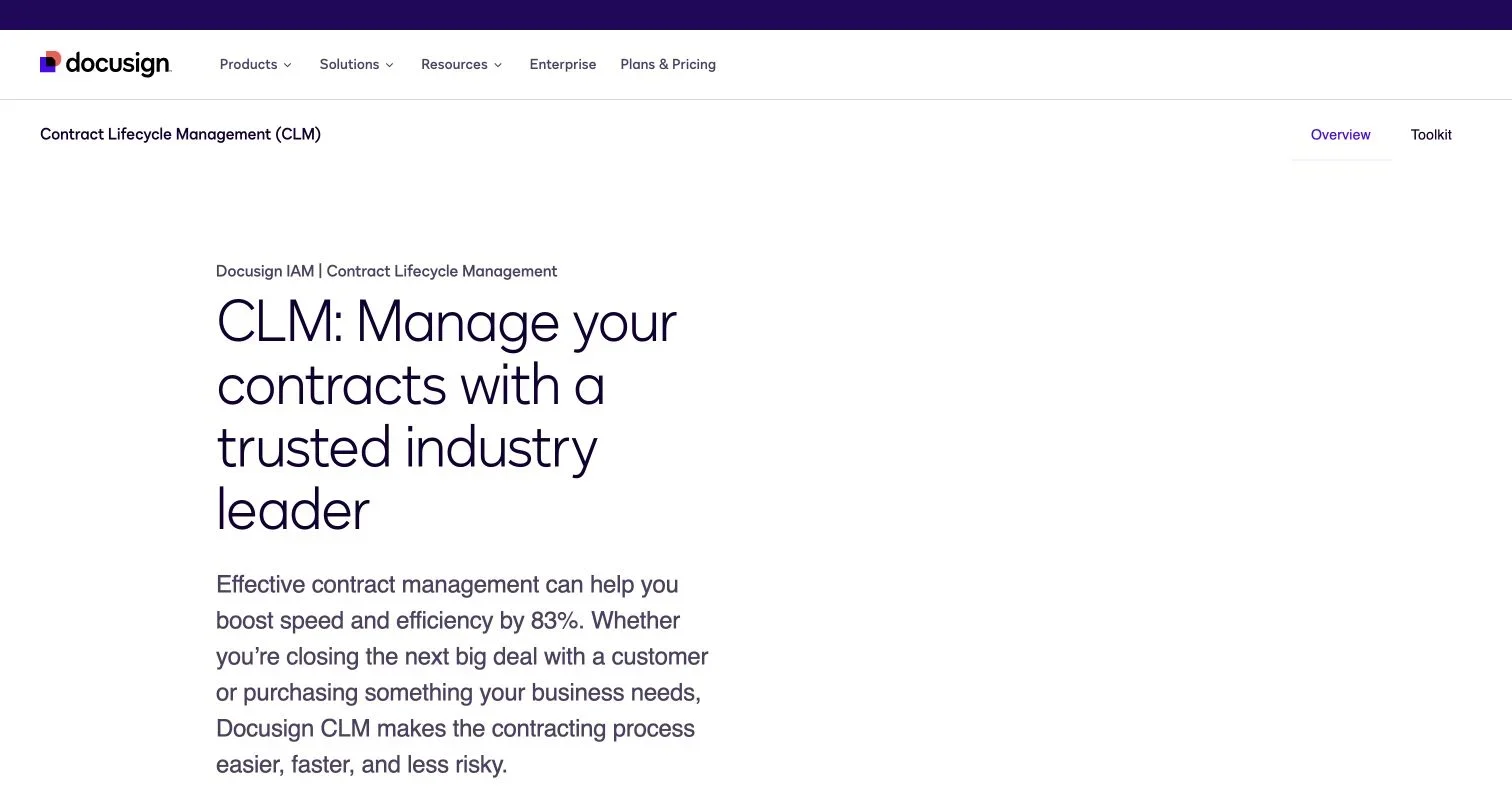
Source page reviewed in Chrome during article research. Follow the image link for the current page.
Start Your CLM Evaluation Checklist With Business Outcomes
Before contacting vendors, document why the organization needs CLM software; vague goals produce vague requirements. Use baseline data from a representative 60- to 90-day period and define the improvement expected within the first year.
| Outcome | Baseline to Measure | Practical Target |
|---|---|---|
| Faster cycle time | Median days from request to signature | Reduce by a defined percentage for each contract type |
| Less legal involvement | Percentage of standard agreements reviewed by legal | Route low-risk contracts through approved self-service paths |
| Better renewal control | Missed notice dates and unwanted renewals | Assign owners and alerts to all material renewals |
| Lower process cost | Hours spent drafting, chasing approvals, and reporting | Automate repeatable work without weakening controls |
| Higher data quality | Contracts with complete metadata | Set a completeness threshold for migrated and new agreements |
Form an evaluation team with legal operations, procurement, security, IT, finance, and at least two business requesters. Name one decision owner and record conflicts. Procurement should not favor price over clause control, nor legal favor drafting depth over user adoption.
Classify requirements as hard gates, scored requirements, or future options. Data-residency rules, required integrations, and access controls may be hard gates. Give little or no weight to features that might matter in three years.
CLM Software Workflow Checklist: Intake Through Negotiation
The first demonstration should follow a complete contract from request onward, using your scenario and sample fields. A vendor-prepared template reveals little about the configuration your team must maintain.
| Item | What to Check | Why It Matters |
|---|---|---|
| Intake | Conditional forms, duplicate detection, required data, and requester status | Poor intake moves administrative work to legal assistants and paralegals |
| Drafting | Templates, clause library, data merging, version control, and fallback language | Controlled drafting reduces manual errors and unnecessary review |
| Approvals | Rules based on value, entity, region, risk, and non-standard terms | Email approvals are difficult to audit and easy to lose |
| Negotiation | Redlines, comments, comparison, playbooks, and external collaboration | Reviewers need one authoritative version and a clear history |
| Signature handoff | Signatory rules, signature integration, and completion status | A broken handoff recreates manual tracking near the finish line |
Test exceptions, not just the happy path: submit a supplier agreement with uncapped indemnity, foreign governing law, personal data, and auto-renewal. The software should route the contract, identify deviation approvers, and preserve the decision.
Ask what administrators can change without vendor services. A drag-and-drop workflow matters only if trained staff can safely modify, test, publish, and restore it. Request an audit trail of contract and workflow-rule changes.
Evaluate Contract Management Software Repositories, Obligations, and Analytics
A repository must connect each executed document with its metadata, amendments, obligations, owners, and access history. Import a messy legacy PDF and locate it by a party-name variation, clause concept, and extracted renewal date.
| Capability | Evaluation Test | Evidence to Request |
|---|---|---|
| Repository | Link amendments and related agreements to the controlling contract | Live search using your sample documents |
| Permissions | Restrict sensitive employment or M&A records | Role and matter-level access demonstration |
| Obligations | Assign an owner, due date, escalation, and completion evidence | Notification log and overdue report |
| Analytics | Filter cycle time, deviations, exposure, and workload | Exportable dashboard built from pilot data |
| Data quality | Detect missing or conflicting metadata | Exception report and correction workflow |
Vendor-reported outcomes can inform tests but do not predict your results. The current Docusign CLM product page reports 449% ROI, use by 2,200 enterprises, a 90% reduction in time spent generating a new sales contract, and an 85% reduction in errors. Ask any vendor to explain the study population, measurement period, setup scope, and costs behind comparable claims.
Source screenshot: Docusign CLM product page. Results are vendor-reported and should be validated against the buyer’s use cases.
Evaluate AI Contract Review in Contract Lifecycle Management Software
AI can accelerate CLM software, but fluent output does not prove legal accuracy. Test each AI function separately: extraction, classification, clause comparison, summarization, risk scoring, drafting, and question answering. Acceptable error rates vary by task: a missed renewal date may have direct financial consequences, while reviewers can more easily correct an imperfect internal summary.
Pilot AI contract review with at least 30 representative contracts, including scans, amendments, unusual formatting, multilingual documents, and varied wording for the same concept. Record false positives, false negatives, unsupported statements, and reviewer time.
Ask the vendor to answer these questions in writing:
- Which models process contract data, and can the provider change them without notice?
- Is customer content used to train shared models, including through subprocessors?
- Can administrators disable generative features by workspace, role, or matter?
- Does every generated answer link back to the supporting clause or page?
- How are prompts, outputs, reviewer corrections, and model versions logged?
- What happens when confidence is low or extraction fields conflict?
- Are retention, deletion, residency, privilege, and legal-hold controls applied to AI data?
Treat source citations and human review controls as basic AI contract review requirements, not premium extras. Ask the system a question the contract does not answer; it should admit the lack of evidence rather than invent a confident response.
Treat CLM Software Integrations and Security as Evaluation Gates
Contracts rarely begin or end in one platform. Map the origins of party data, pricing, approvals, signatures, invoices, and obligations, then identify each field’s system of record. Without this map, integrations can create duplicates and conflicts.
| Area | What to Verify | Warning Sign |
|---|---|---|
| Business systems | CRM, procurement, ERP, e-signature, identity, email, and collaboration tools | Connector supports only a narrow or outdated workflow |
| API and events | Documented APIs, webhooks, limits, retry handling, and service accounts | Important actions require screen scraping or manual exports |
| Identity | SSO, SAML, SCIM, multifactor authentication, and role separation | User removal depends on a periodic spreadsheet |
| Data protection | Encryption in transit and at rest, backups, recovery, and secure deletion | Vendor provides policy language, but no test evidence |
| Assurance | Current SOC 2 Type II report, ISO 27001 scope, penetration testing, and incident process | Certification excludes the CLM service or major subprocessors |
| Privacy | DPA, data locations, subprocessors, transfer mechanism, and retention controls | Contract data moves regions without customer control |
Review both the software provider and setup partner because consultants may receive broad migration and configuration access. Require named roles, least-privilege access, logging, confidentiality terms, and a defined access-removal date.
During the pilot, have IT test one CRM, ERP, or procurement integration from upstream record creation through agreement generation, controlled-field changes, signature, and metadata return. Arrows between logos are not integration evidence.
Run Scenario-Based CLM Software Demos and a Measurable Pilot
Give shortlisted vendors identical scripts, sample contracts, and time limits so each tackles the same workflows. Record sessions so reviewers can verify scores.
A useful pilot sequence is:
- Submit a standard request and generate an approved template.
- Introduce a non-standard clause and verify the approval route.
- Negotiate two document versions with an external party.
- Complete signature and confirm repository filing.
- Extract obligations, assign owners, and trigger an alert.
- Produce an audit trail and a cycle-time report.
- Repeat a task with a paralegal or business user who received minimal training.
Customer outcomes can suggest benchmarks. On its CLM page, Docusign reports that T-Mobile Wholesale achieved 1.8 times faster cycle time for high-value agreements and freed 40% of staff from contracting tasks. Genuine Parts Company reportedly supported more than 10 use cases across five departments. Vestwell reduced agreement-package creation from 75 minutes to five and reported 70% fewer drop-offs. The page also states that 78% of iCIMS agreements do not require legal intervention while custom-agreement volume grew fivefold without increasing turnaround time.
These examples do not promise results. Ask what process changes, integrations, staffing, and measurement rules produced each case-study figure. Base pilot success criteria on your baseline and contract mix.
Use a Weighted CLM Evaluation Checklist and Scoring Model
Score evidence, not presentation quality. Use a 0–5 scale: 0 means absent; 1, requiring custom development; 3, working with configuration; and 5, working well in the pilot with clear administrative control.
| Category | Suggested Weight | What the Score Should Cover |
|---|---|---|
| Intake, drafting, approvals, and negotiation | 22% | Complete workflow coverage and exception handling |
| Repository, obligations, and analytics | 16% | Search, permissions, reporting, ownership, and data quality |
| Security, privacy, and governance | 17% | Assurance evidence, access control, residency, retention, and auditability |
| Integrations and architecture | 13% | Required connectors, APIs, events, reliability, and data ownership |
| AI capabilities | 12% | Accuracy, traceability, controls, model governance, and reviewer effort |
| Setup and adoption | 10% | Migration, configuration, training, accessibility, and support |
| Pricing and contract terms | 10% | Total cost, predictability, renewal protection, and exit rights |
Calculate each category as weight × score ÷ 5, then add the results for a maximum of 100. Keep hard gates outside the total; attractive analytics cannot offset a mandatory residency or security failure.
Apply an evidence factor when claims remain untested: 1.0 for pilot-verified performance, 0.8 for a live demonstration, and 0.5 for roadmap or written claims. Preserve raw and adjusted scores to show where uncertainty changed results. Require evaluators to add a short rationale and evidence link for every score below 2 or above 4.
Evaluate Contract Management Software Implementation, Pricing, and Terms
Setup determines whether the software becomes infrastructure or an expensive repository. Request a plan for design, configuration, migration, testing, training, launch, and support. The statement of work should name responsible parties, assumptions, deliverables, acceptance tests, and change-order rates.
| Item | What to Check | Why It Matters |
|---|---|---|
| Licensing | Seats, roles, contract volume, storage, API use, and AI consumption | A low entry price can expand sharply with adoption |
| Services | Configuration, integration, migration, training, and project management | Professional services may exceed first-year license cost |
| Data migration | Deduplication, OCR, metadata validation, and exception handling | Poor legacy data weakens search and AI results |
| Support | Response times, named contacts, premium tiers, and upgrade assistance | Contracting interruptions can affect revenue and purchasing |
| Renewal | Price caps, notice dates, usage reconciliation, and audit rights | Predictability matters more than a temporary discount |
| Exit | Export formats, metadata, audit history, assistance, deletion, and fees | The organization must be able to change platforms later |
Model the software’s total cost over at least three years. Include internal legal-operations time, IT work, setup partners, integrations, migration, AI add-ons, sandbox access, storage growth, support, and expected overages. Run low-, expected-, and high-adoption scenarios.
A smaller organization may start with a narrower workflow if the software offers clean exports and a credible expansion path. A phased rollout is usually safer: start with one high-volume, repeatable process, measure adoption and cycle time, fix friction, then expand.
Conclusion
The strongest evaluation uses evidence from your contracts, users, controls, and economics. Define measurable outcomes, then test complete workflows and difficult exceptions. Examine repository quality, obligations, AI accuracy, integrations, security, setup work, and three-year cost with the same discipline.
A weighted checklist creates consistency but never overrides a hard legal, privacy, or security requirement. Adjust scores for the quality of evidence, document assumptions, and separate current capability from roadmap promises.
Choose software that ordinary requesters can use and internal administrators can govern; platforms requiring constant vendor intervention will struggle. Contract lifecycle management software succeeds when it reduces avoidable work while preserving the judgment, accountability, and audit trail legal and procurement teams need.
Frequently Asked Questions
How long should a CLM software evaluation take?
The timeline depends on complexity, but it should allow enough time to establish baselines, run consistent vendor demonstrations, and complete a measurable pilot. Avoid shortening the process in ways that prevent users, integrations, security controls, and exception workflows from being tested.
Which stakeholders should participate in selecting CLM software?
Include legal operations, procurement, security, IT, finance, and representative business requesters. Assign one decision owner, document competing priorities, and involve the people who will administer and use the platform, not only senior approvers.
What should be treated as a hard gate rather than a scored feature?
Hard gates commonly include data residency, security and privacy controls, required integrations, access management, and mandatory regulatory requirements. A vendor that fails one of these conditions should not advance simply because it scores well elsewhere.
How can we tell whether a vendor demonstration reflects real performance?
Give every shortlisted vendor the same scripts, sample contracts, edge cases, and time limits. Require live evidence using your documents and workflows, then distinguish pilot-verified results from demonstrations, written claims, and roadmap promises.
How should we evaluate AI contract review accuracy?
Test at least 30 representative contracts covering scans, amendments, unusual layouts, multilingual content, and varied clause wording. Track missed issues, false alerts, unsupported answers, source traceability, and the amount of reviewer time required to correct results.
What costs should be included beyond the CLM license price?
Model at least three years of configuration, migration, integrations, training, internal staff time, support, storage, API usage, AI add-ons, and likely overages. Compare low-, expected-, and high-adoption scenarios, and review renewal protections and exit costs.
Should an organization roll out CLM software all at once?
A phased rollout is usually safer, starting with one high-volume and repeatable contracting process. Measure adoption, cycle time, data quality, and user friction before expanding to additional agreement types or departments.