
12 Best AI Legal Research Tools in 2026
Table of Contents
- Introduction
- Lexis+ AI: Enterprise-Grade Legal Intelligence
- Westlaw CoCounsel: Model-Agnostic Research Architecture
- vLex Vincent: Global Legal Research at Scale
- Casetext CoCounsel: Litigation-Focused AI Assistant
- Fastcase: Accessible AI for Smaller Practices
- Lex Machina: Litigation Analytics Powered by AI
- Free Law Project: Open-Source Legal Research
- Harvey AI: Generative AI Built for Law Firms
- ROSS Intelligence
- Blue J Legal: AI-Powered Tax and Employment Law Research
- CaseMetrix: Document Analysis and Timeline Generation
- Judicata: Semantic Search for Case Law
- Understanding Hallucination Risks Across Platforms
- Shepard’s Citations Versus KeyCite
- Selecting the Right AI Legal Research Platform for Your Practice
- End
- Introduction
- Lexis+ AI: Enterprise-Grade Legal Intelligence
- Westlaw CoCounsel: Model-Agnostic Research Architecture
- vLex Vincent: Global Legal Research at Scale
- Casetext CoCounsel: Litigation-Focused AI Assistant
- Fastcase: Accessible AI for Smaller Practices
- Lex Machina: Litigation Analytics Powered by AI
- Free Law Project: Open-Source Legal Research
- Harvey AI: Generative AI Built for Law Firms
- ROSS Intelligence
- Blue J Legal: AI-Powered Tax and Employment Law Research
- CaseMetrix: Document Analysis and Timeline Generation
- Judicata: Semantic Search for Case Law
- Understanding Hallucination Risks Across Platforms
- Shepard’s Citations Versus KeyCite
- Selecting the Right AI Legal Research Platform for Your Practice
- End
Introduction
Legal research has transformed significantly due to AI legal research tools becoming crucial in law firms of all sizes. Accuracy issues and inconsistent pricing are concerns, and selecting the wrong platform can be costly. A Stanford HAI study found hallucination rates from 17% to 82%, depending on the platform. Therefore, choosing the right AI legal research software is about risk management, not just features. This guide explores twelve platforms, detailing their AI architectures, accuracy data, and deployment considerations.
Lexis+ AI: Enterprise-Grade Legal Intelligence
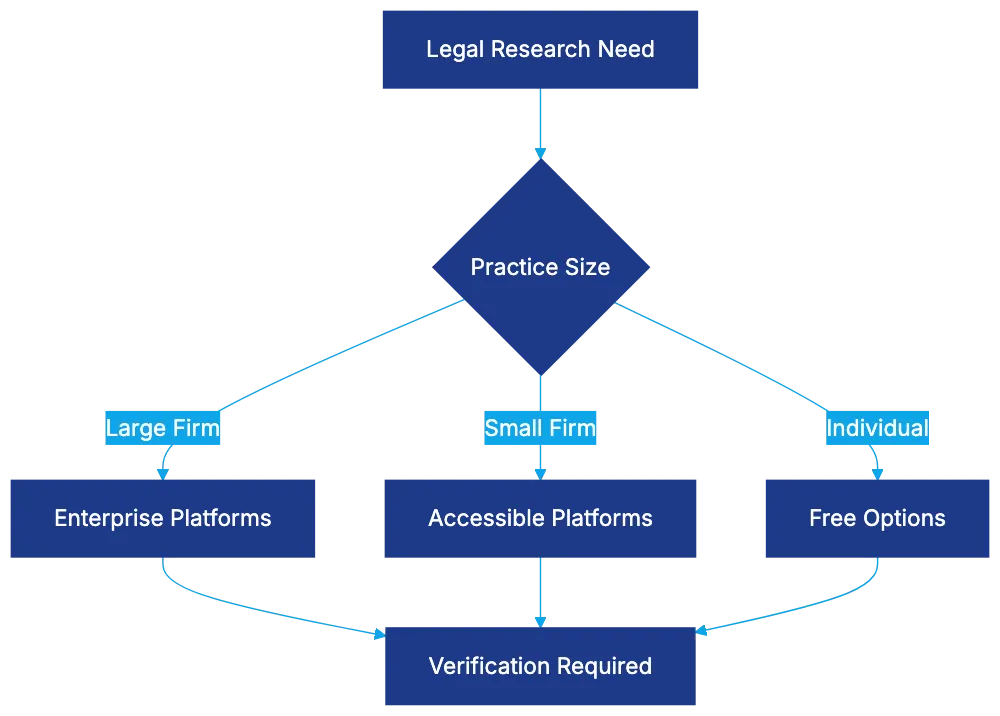
AI Legal Research Platform Landscape:
Lexis+ AI uses Anthropic Claude and OpenAI GPT-4 in a dual-model approach. It ensures data privacy by not using queries for model training. The platform trained on over 1.23 million legal documents, uses Shepard’s for citation verification, and reduces manual verification time. Lexis+ AI’s hallucination rate is over 17% for complex queries, more accurate than GPT-4’s range. It’s suitable for preliminary research with judgment still required. Pricing starts at $60-$75 monthly per user, with considerations for switching costs, as noted by LexisNexis CTO.
Westlaw CoCounsel: Model-Agnostic Research Architecture
Westlaw CoCounsel uses a model-agnostic design, supporting various cutting-edge models. Using retrieval-augmented generation, it pulls from Westlaw’s library to anchor responses. The Deep Research feature plans arguments for both sides of legal issues. Inline citations with KeyCite flags verify case history. Westlaw AI’s hallucination rate is over 34%, better than raw GPT-4. Pricing is $75-$100 per user monthly, serving litigation and transactional work needs, according to Forbes.
vLex Vincent: Global Legal Research at Scale
vLex Vincent combines Claude, Llama2, and GPT-4, ideal for cross-border and comparative law research. Over a billion documents from 100+ countries are indexed, with cross-language capabilities. It operates on a 70% confidence threshold to reduce hallucination risks. Pricing starts around $45 for basic access, rising to $150+ for full coverage, as reported by Forbes.
Casetext CoCounsel: Litigation-Focused AI Assistant
Casetext CoCounsel, acquired by Thomson Reuters, caters to litigation with AI tools for deposition prep, contract review, and legal memos. It uses GPT-4 with retrieval-augmented generation tied to Casetext’s database. Pricing starts at $89 per user per month, fitting for small firms requiring enterprise-level research.
Fastcase: Accessible AI for Smaller Practices
Fastcase is bundled with bar memberships in many states, providing free access to AI features. It uses semantic search rather than generative AI for enhanced results. Pricing runs about $83 per month, serving routine practice areas effectively.
Lex Machina: Litigation Analytics Powered by AI
Platform Accuracy Comparison:

Lex Machina provides analytics instead of traditional searches, analyzing litigation outcomes and strategies. The system queries datasets to identify patterns, with over 95% accuracy in entity identification. Pricing ranges from $15,000 to $30,000 annually.
Free Law Project: Open-Source Legal Research
Free Law Project offers open-access research through CourtListener. It enhances search results without subscription costs. The database includes federal opinions and some state decisions, supplementing universal practice areas.
Harvey AI: Generative AI Built for Law Firms
Harvey, using GPT-4 with legal tuning, covers research, drafting, and due diligence for large firms. Pricing is likely $500-$1,000+ monthly per user.
ROSS Intelligence
ROSS Intelligence used natural language processing for legal research until ceasing operations in 2023. Legal battles highlight the need for clear licensing agreements.
Blue J Legal: AI-Powered Tax and Employment Law Research
Blue J Legal predicts tax and employment law outcomes, offering probability assessments based on past rulings. Pricing is $2,000 to $10,000 annually.
CaseMetrix: Document Analysis and Timeline Generation
CaseMetrix automates document review, generating timelines from legal documents. Pricing starts around $5,000, fitting strategic litigation budgets.
Judicata: Semantic Search for Case Law
Now part of Casetext, Judicata pioneers semantic search using conceptual matches to find relevant case law.
Understanding Hallucination Risks Across Platforms
AI Legal Research Workflow:
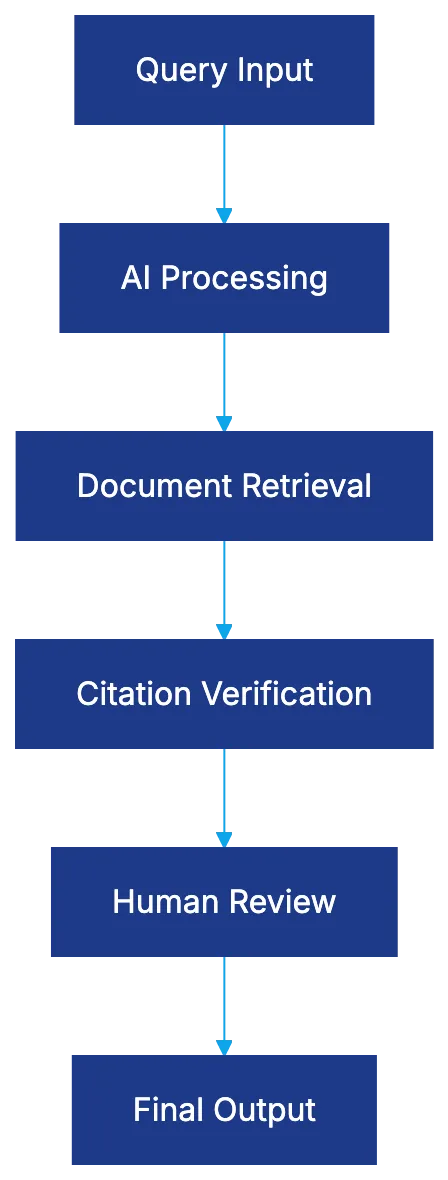
Stanford HAI study shows hallucination rates above 34% for Westlaw, over 17% for Lexis+, and 49%-82% for GPT-4. Verification systems like Shepard’s and KeyCite are essential for accuracy.
Shepard’s Citations Versus KeyCite
Shepard’s and KeyCite verify citations differently but effectively, supporting professional judgment by minimizing manual steps.
Selecting the Right AI Legal Research Platform for Your Practice
Choosing a platform involves more than features. Lexis+ AI or Westlaw CoCounsel may integrate well if already in use. Practice area specificity and budget are crucial. Accuracy needs vary; higher error tolerance is acceptable for preliminary research. Platform choice matters less than understanding AI capabilities and reliability by 2026.
End
AI legal research tools are essential but don’t replace judgment. Platforms like Lexis+ AI and Westlaw CoCounsel lead, while tools like Lex Machina provide niche capabilities. Human oversight is still needed, but these tools offer substantial benefits.
Frequently Asked Questions
What considerations should I keep in mind when selecting an AI legal research tool?
When selecting an AI legal research tool, consider factors such as your practice size, specific legal needs, user-friendliness, and the accuracy rates of the platforms. Additionally, evaluate pricing structures and whether the tool supports citation verification systems to ensure reliability in your research outcomes.
What is the hallucination rate in AI legal research tools, and why is it important?
The hallucination rate refers to the frequency with which an AI model produces incorrect or nonsensical information. Understanding these rates is crucial as they indicate the reliability of the tool for legal research, impacting the quality of insights derived from it. Platforms like Lexis+ AI and Westlaw CoCounsel have lower hallucination rates compared to others, making them more trustworthy options.
How does pricing vary among different AI legal research platforms?
Pricing for AI legal research tools can vary significantly based on features and target users. For instance, Lexis+ AI and Westlaw CoCounsel range from $60 to $100 per user monthly, while specialized platforms like Lex Machina can cost $15,000 to $30,000 annually. It’s vital to assess your budget in relation to the features offered by each platform.
Can smaller law firms access AI legal research tools without breaking the bank?
Yes, smaller firms have options for accessing AI legal research tools through platforms like Fastcase, which is often included with state bar memberships. Additionally, more affordable plans are available for foundational features on platforms like vLex Vincent, helping these firms utilize AI without significant financial burdens.
What role does human oversight play in using AI legal research tools?
Human oversight is essential when utilizing AI legal research tools, as these platforms can still produce inaccuracies despite advancements. Legal professionals should verify AI-generated information, especially in high-stakes situations. The combination of human judgment and AI-generated insights leads to more reliable outcomes.
How do citation verification features like Shepard's and KeyCite enhance AI research?
Citation verification features such as Shepard's and KeyCite play a critical role in enhancing the accuracy of AI research by ensuring that cited cases and legal precedents are valid and up-to-date. These tools help minimize the risk of relying on outdated or incorrect legal references, thus improving the quality of legal documents and analyses.
What are the best AI legal research options for individual practitioners?
Individual practitioners can benefit from free tools like the Free Law Project, which offers open-access research, or more affordable tiered access options like vLex Vincent. Additionally, platforms such as Fastcase provide valuable AI features bundled with bar memberships, allowing solo practitioners to utilize advanced legal research tools without a large investment.