AI Transforming Law: Complete Guide for Legal Professionals
Table of Contents
- Introduction
- From Keyword Search to Semantic Understanding: The Evolution of Legal AI
- The Current State: Who’s Using What and Why the Numbers Matter
- Transformation by Practice Area: Where AI Changes Everything
- The Jobs Question: What Happens to Legal Careers
- Effective Statistics: Measuring What Actually Changes
- Legal AI Trends: What’s Coming Next
- Implementation Realities: What Actually Works
- Ethical and Professional Responsibility Considerations
- End
- Introduction
- From Keyword Search to Semantic Understanding: The Evolution of Legal AI
- The Current State: Who’s Using What and Why the Numbers Matter
- Transformation by Practice Area: Where AI Changes Everything
- The Jobs Question: What Happens to Legal Careers
- Effective Statistics: Measuring What Actually Changes
- Legal AI Trends: What’s Coming Next
- Implementation Realities: What Actually Works
- Ethical and Professional Responsibility Considerations
- End
Introduction
AI in legal has revolutionized the industry, shifting from manual review and billable hours to automation. AI in legal encompasses contract analysis, deal review, and more, reshaping law practice.
In an Am Law 100 firm today, AI systems handle tasks for associates who previously billed 2,000 hours annually. 64% of these firms use Kira Systems for contract review, 84% of the top 25 M&A firms deploy AI for deal analysis, and Icertis manages contracts for a third of Fortune 100 companies, significantly altering the legal landscape.
From Keyword Search to Semantic Understanding: The Evolution of Legal AI
Legal technology has evolved from basic keyword search to semantic AI, a change crucial for AI’s future in law.
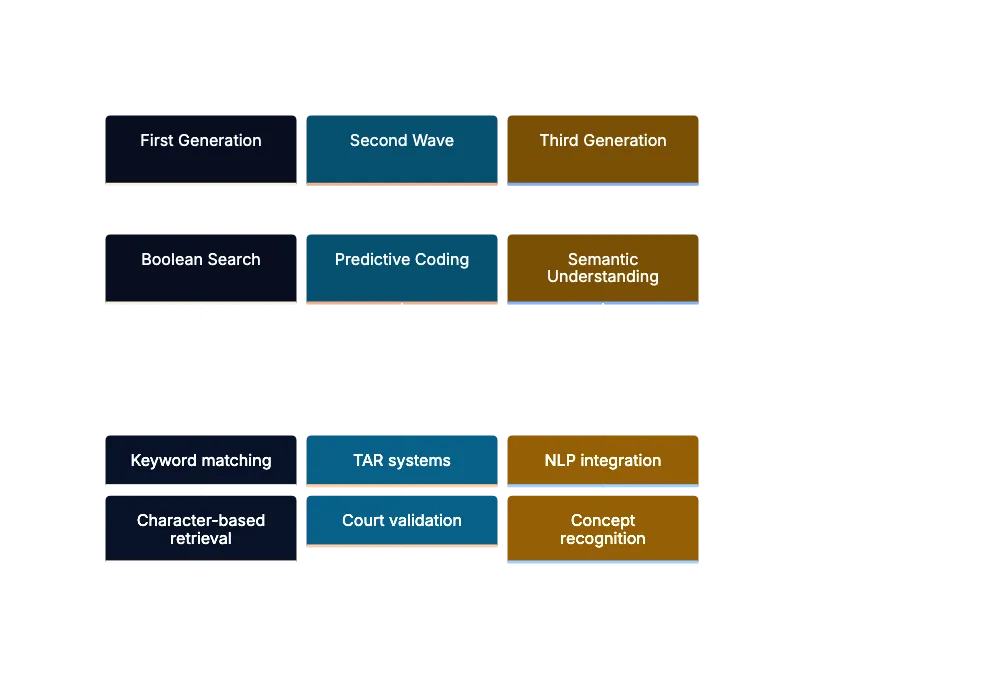
Evolution of Legal AI Technology:
-
First Generation: In the 1990s and early 2000s, Boolean search used operators like AND, OR, and NOT for case database searches. It matched characters but couldn’t understand meaning.
-
Second Wave: Around 2010, predictive coding and TAR identified relevant documents more effectively, validated by court acceptance.
-
Third Generation: Today, AI uses natural language processing to understand legal concepts and risks in documents, enhancing the value proposition.
The Current State: Who’s Using What and Why the Numbers Matter
Claims of AI transforming law require quantifiable backing to guide investments and career planning.
- E-Discovery: 198 of the Am Law 200 firms use Relativity for e-discovery, showing its standardization in litigation.
- Contract Analysis: Kira Systems, used by 64% of Am Law 100 firms, enhances due diligence efficiency in M&A.
- Contract Lifecycle Management: Icertis handles over $1 trillion in contracts for 33% of Fortune 100 companies, shifting corporate operations.
AI adoption is targeted, influencing practice development and career paths.
Transformation by Practice Area: Where AI Changes Everything
AI’s impact varies by practice area:
AI Impact by Practice Area:
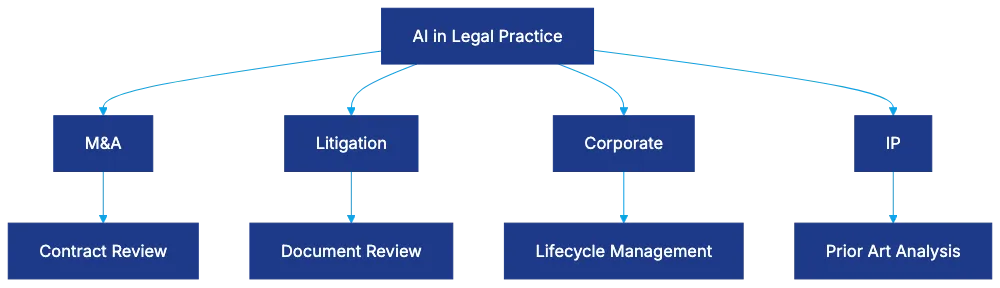
- M&A: Contract review times reduced from weeks to days.
- Litigation: TAR reduces document review time by 40-60%.
- Corporate Practice: Lifecycle management cuts review time by 70-85%.
- Intellectual Property: AI improves filing strategies by analyzing prior art and predicting behavior, saving time.
In counseling, negotiation, or advocacy, AI assists but human judgment remains crucial.
The Jobs Question: What Happens to Legal Careers
AI’s impact on legal careers is significant.
- Disappearing Document Review: AI handles 70% of traditional review. Junior roles are being restructured.
- Emergence of Legal Operations: New roles in tech management and workflow analysis are arising.
- Shift in Associate Work: Focus is now on strategic oversight, validating AI results.
- Evolution of Paralegal Roles: Demand grows for tech specialists managing AI platforms.
Legal Career Transformation:
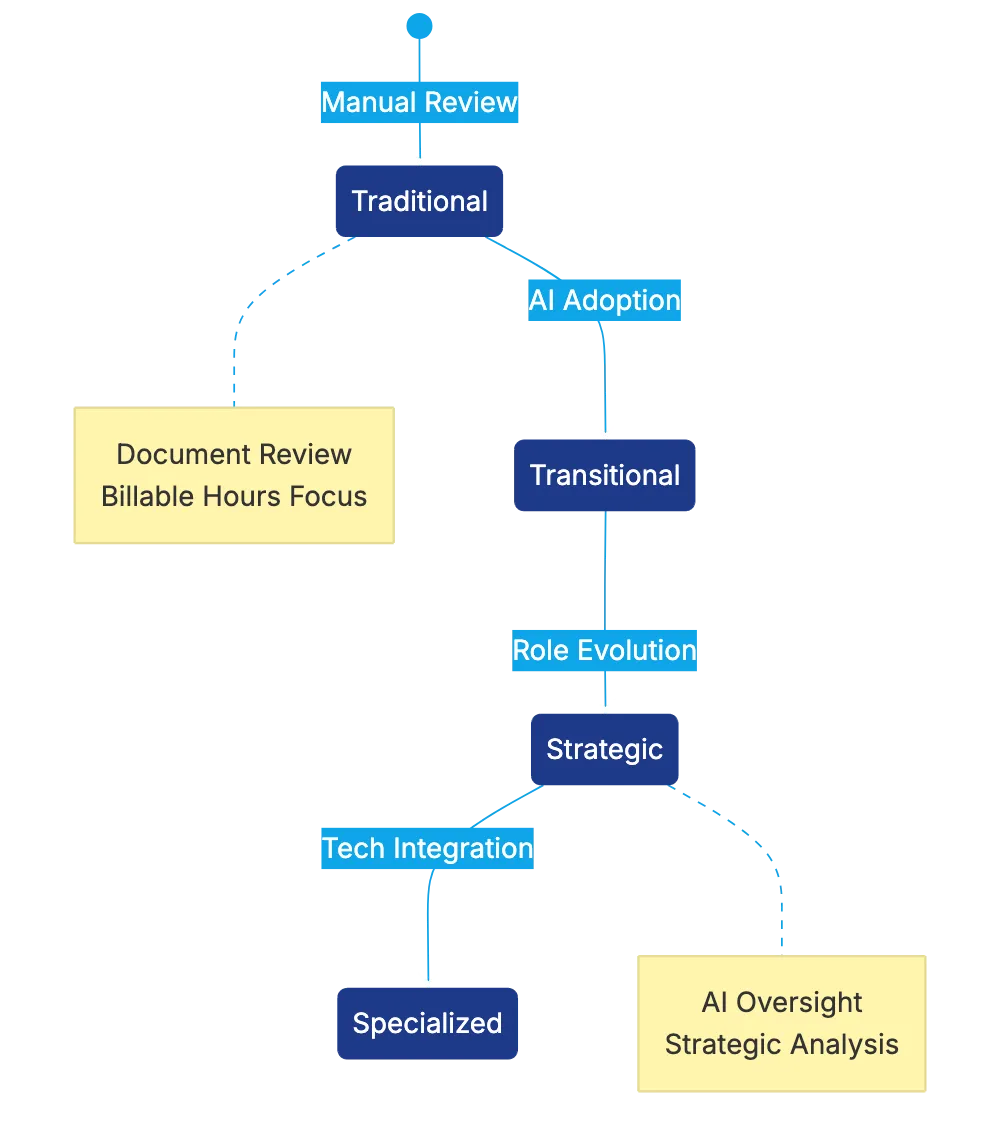
Roles evolve, providing new strategic opportunities.
Effective Statistics: Measuring What Actually Changes
Legal professionals require concrete data beyond marketing claims.
- Smokeball’s Impact: Users gain $135,000 in billable time annually through automation.
- MyCase Users Gain: 64 hours annually regained, refocusing on substantive work.
- Contract Analysis Efficiency: AI reduces review times from 45 to 12 minutes, increasing capacity by 40%.
- E-Discovery Cost Drop: Costs per gigabyte fell from $18,000 to $1,800.
- Contract Cycle Time: Icertis users report 60-80% faster approval cycles.
Time saved boosts profitability and service quality.
Legal AI Trends: What’s Coming Next
Future AI trends inform strategic decisions:
- Agentic AI Workflows: Upcoming AI tools autonomously complete workflows.
- Embedded AI: Future intelligence will embed in existing tools.
- Consolidation in Legal Tech: Demand for integrated platforms leads to startups being acquired.
- Generative AI for Drafting: Useful for routine documents, not complex drafting.
- Predictive Analytics in Litigation: Enhanced tools predict case outcomes and settlements.
AI workflows signify major delivery changes.
Implementation Realities: What Actually Works
Successful AI deployment hinges on change management:
- Change Management: Attorney input and advocacy aid in successful implementations.
- Data Quality: Clean data is essential; AI can’t fix poor inputs.
- Vendor Diligence: Careful selection and proof-of-concept testing are vital.
- Integration with Existing Systems: Adoption depends on seamless integration.
- Workflow Redesign: Focus on process innovation ensures success.
Firms viewing AI as process innovation see the best outcomes.
Ethical and Professional Responsibility Considerations
AI poses responsibility challenges in law:
- Competence Requirements: Lawyers must understand AI tools for accuracy.
- Confidentiality Concerns: Client data use requires scrutiny.
- Client Notification: Transparency in AI use is often preferred.
- Billing Implications: Value-based fees address compressed timelines.
- Supervision Responsibilities: Partners remain responsible for AI outputs.
Ethics require understanding AI’s impact on legal practice.
End
The AI legal industry’s transformation is undeniable. With 64% of Am Law 100 utilizing Kira, 84% of top M&A firms using AI, and significant gains in document review, statistics reflect its impact. Future developments depend on adaptation; successful lawyers leverage AI for enhanced judgment.
Trends suggest more embedded intelligence and agentic workflows, reshaping legal services. Embracing these changes is crucial to capitalize on AI potential and avoid disruption.
Frequently Asked Questions
How will AI affect the workload of junior associates in law firms?
AI is likely to reduce the demand for traditional document review tasks, which have previously occupied a significant portion of junior associates' time. As AI handles up to 70% of these tasks, the roles of junior associates will shift towards more strategic responsibilities, such as validating AI results and focusing on higher-level legal analysis.
What are the main benefits of using AI in contract analysis?
AI significantly enhances the efficiency of contract analysis by drastically reducing review times, improving accuracy, and enabling better risk assessment. For example, tools like Kira Systems can streamline due diligence work in M&A, allowing lawyers to focus on strategic aspects instead of tedious document reviews.
Which areas of legal practice are most impacted by AI?
AI is transforming various legal practice areas, including M&A, litigation, corporate law, and intellectual property. In M&A, for instance, AI has reduced contract review times from weeks to days, while in litigation, technology-assisted review (TAR) methods have sped up document review processes significantly.
What should firms consider before implementing AI solutions?
Firms should prioritize change management strategies, ensuring attorney involvement to facilitate smoother implementations. Additionally, the quality of data is crucial, and careful vendor selection along with testing proof-of-concept solutions can significantly impact the success of AI deployments.
How does AI integration affect the cost of legal services?
AI can potentially reduce the costs of legal services by streamlining document review and other time-consuming tasks, leading to more efficient workflows. For example, costs per gigabyte for e-discovery have decreased dramatically, suggesting that firms can offer competitive pricing while maintaining service quality.
What ethical considerations should lawyers keep in mind when using AI?
Lawyers must ensure they are competent in using AI tools, understand privacy and confidentiality concerns, and maintain transparency with clients regarding AI's role in their cases. Additionally, lawyers remain accountable for the AI outputs, making it essential to supervise the use of technology in their practice.
What trends can we expect in the future of AI in legal practice?
Future trends in legal AI include the development of agentic workflows that autonomously execute tasks, the integration of AI into existing software, and advancements in predictive analytics to foresee case outcomes. These innovations will continue to reshape how legal services are delivered and enhance the effectiveness of legal professionals.
Related Articles

Ironclad's Unique Approach to Contract Management
Explore Ironclad's innovative contract management platform, emphasizing automation, AI, and seamless integrations for legal teams.

Discover Juro: A Modern Approach to Contract Management
Explore how Juro transforms contract management with a browser-native platform, streamlining workflows and enhancing collaboration.

Legal Practice Management Software: Key Features & AI Insights
Explore the evolution of legal practice management software and how AI enhances law firm operations, trust accounting, and time tracking.