AI Due Diligence: Revolutionizing M&A Transactions
Table of Contents
- Introduction
- From Passive Repository to Active Advisor
- Document Classification That Actually Works
- Key Term Extraction at Scale
- M&A-Specific Provisions That Make or Break Deals
- Employment Analysis and Golden Parachute Issues
- Anomaly Detection and Unknown Unknowns
- Platform Deep Dive: Luminance
- Platform Deep Dive: Kira Systems
- Implementation Considerations for Legal Teams
- Common Pitfalls and How to Avoid Them
- Measuring ROI and Effectiveness Gains
- Future Developments and What’s Coming
- Introduction
- From Passive Repository to Active Advisor
- Document Classification That Actually Works
- Key Term Extraction at Scale
- M&A-Specific Provisions That Make or Break Deals
- Employment Analysis and Golden Parachute Issues
- Anomaly Detection and Unknown Unknowns
- Platform Deep Dive: Luminance
- Platform Deep Dive: Kira Systems
- Implementation Considerations for Legal Teams
- Common Pitfalls and How to Avoid Them
- Measuring ROI and Effectiveness Gains
- Future Developments and What’s Coming
Introduction
The due diligence phase has been the bottleneck in M&A transactions, with legal teams sifting through documents to find crucial provisions. The process was linear and manual. AI due diligence tools revolutionize this by acting as active advisors, highlighting anomalies human reviewers might miss. This transformation shifts document review from a checklist exercise to a strategic intelligence operation.
From Passive Repository to Active Advisor
Traditional vs AI Due Diligence Workflow:
Traditional due diligence relied on keyword searches, which missed variations. A search for “change of control” might not catch “deemed sale.” Documents were reviewed sequentially, extending timelines to months. AI due diligence changes this by classifying documents upon upload using machine learning models, categorizing them into relevant buckets like Financial, Legal, HR, IP, and Real Estate. Semantic search replaces keyword matching, compressing review cycles from months to days, transforming storage into analysis.
Document Classification That Actually Works
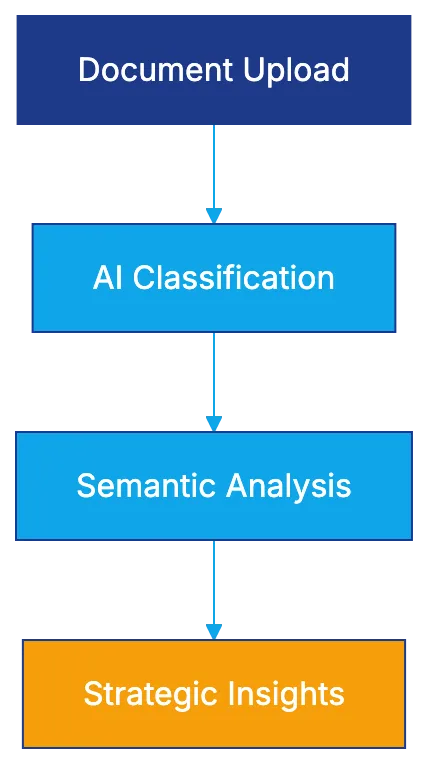
Organizing 75,000 documents with inconsistent names and types presented challenges. Traditional organization required sellers to pre-organize or paralegals to manually classify documents, leading to errors and delays. Automated due diligence uses multi-stage classification, analyzing metadata and actual content. Machine learning, trained on legal documents, assigns categories with confidence scores. Modern due diligence software uses legal-specific taxonomies developed by practitioners, allowing associates to reclassify documents, which feed back into the model.
AI Document Classification Process:

Key Term Extraction at Scale
After organization, extracting important provisions for transaction analysis delivers significant time savings. Instead of reading each contract, AI extracts data points from thousands of agreements. Kira Systems pioneered Smart Fields, offering over 1,400 pre-built fields across 40 practice areas, using machine learning to understand legal concepts contextually. Luminance uses its LITE Engine combining pattern recognition with machine learning, learning from attorney feedback and discovering new patterns.
M&A-Specific Provisions That Make or Break Deals
Certain provisions can impact M&A transactions. AI due diligence excels in extraction. Change-of-control provisions in agreements may require consent from many parties. In 2022, AI discovered 47 agreements needing consent, versus 31 flagged manually. Assignment restrictions vary, impacting deal structures. Most favored nation provisions can create contingent liabilities, ensuring terms equal to others.
Employment Analysis and Golden Parachute Issues
Employment provisions create post-closing obligations and tax complications. AI due diligence tools analyze employment agreements and compensation across workforces. Golden parachute provisions trigger taxes under IRS codes 280G and 4999 if payments exceed thresholds, using single or double-trigger mechanisms.
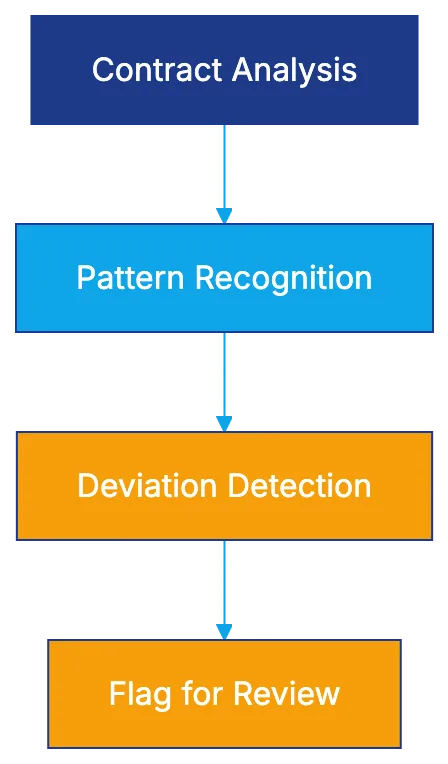
AI Anomaly Detection Flow:
Anomaly Detection and Unknown Unknowns
M&A due diligence AI finds unexpected provisions. Anomaly detection uses machine learning to identify outliers, flagging contracts deviating from established patterns, revealing non-standard terms.
Platform Deep Dive: Luminance
Luminance, leveraging a Legal Pre-trained Transformer (LITE) trained on over 150 million documents, is cutting-edge AI due diligence for legal teams.
Platform Deep Dive: Kira Systems
Kira Systems, now part of Litera, focuses on contract analysis with Smart Fields, gradually expanding into full due diligence workflows.
Implementation Considerations for Legal Teams
AI due diligence adoption requires more than software. Success needs workflow redesign, team training, and technological integration. Leading firms create AI-first protocols, routing materials through platforms from the start for initial classification and extraction.
Common Pitfalls and How to Avoid Them
Even advanced AI due diligence makes errors. Reliance on automation without verification leads to malpractice risks. Findings should serve as starting points, with verification essential.
Measuring ROI and Effectiveness Gains
Efficiency claims require concrete metrics. Time savings provide a clear ROI. Traditional 50,000 document reviews take 6-8 weeks with 4-6 associates. With AI, it cuts to 2-3 weeks with 2-3 associates.
Future Developments and What’s Coming
The next generation of AI due diligence will evolve. Multimodal analysis will include numerical data, charts, and visuals within contracts, beyond text-based provisions.
Frequently Asked Questions
How does AI improve the due diligence process in M&A transactions?
AI enhances the due diligence process by automating document classification and anomaly detection, allowing legal teams to analyze documents more efficiently. By using machine learning, these tools categorize documents and extract key provisions quickly, reducing review times from months to days.
What are the main benefits of using AI due diligence tools?
The key benefits include significant time savings, improved accuracy in identifying important contractual provisions, and better organization of documents. These tools minimize human error and help legal teams focus on strategic analysis rather than just document review.
What types of documents can AI due diligence tools classify?
AI due diligence tools can classify a variety of documents including financial statements, legal contracts, HR documents, intellectual property files, and real estate agreements. They employ tailored legal taxonomies to ensure accurate categorization based on content and metadata.
How do AI tools handle inconsistent document naming and types?
AI tools address inconsistencies by utilizing sophisticated algorithms that analyze both metadata and content. This automated classification process significantly reduces the need for manual sorting and minimizes errors caused by inconsistent document naming.
What precautions should firms take when using AI in due diligence?
Firms should remain cautious by verifying findings from AI outputs, as reliance on automation without verification can pose malpractice risks. It's essential to treat AI-generated insights as starting points for further analysis rather than final conclusions.
How can firms measure the ROI of implementing AI tools for due diligence?
Firms can measure ROI by comparing the time taken for traditional document reviews to those utilizing AI tools. For example, a reduction in the number of associates required and the overall time spent on reviews indicates clear financial benefits and efficiency gains.
What future developments can we expect in AI due diligence?
The future of AI due diligence may include multimodal analysis that integrates numerical data, visual elements, and charts within contracts. This advancement will enable legal teams to gain deeper insights beyond just text-based information.
Related Articles

Harvey AI Review: Advanced Legal AI for Law Firms
Explore how Harvey AI transforms legal workflows, offering tailored solutions and superior performance for large law firms.

Understanding E-Discovery Software in 2026
Explore how AI-powered e-discovery software transforms legal document review with efficiency and accuracy.

Review of Spellbook AI for Legal Professionals
Explore how Spellbook AI enhances contract drafting and review for legal professionals with Microsoft Word integration.