The Importance of Clause Libraries in Legal Practice
Table of Contents
- The Importance of a Clause Library in Legal Practice
- The Challenges of Traditional Contract Drafting
- Key Advantages of Standardized Clause Management
- Transforming Clause Management with AI
- Version Control and Audit Trail Management
- Benchmarking and Market Standard Comparison
- Seamless Integration into Drafting Workflows
- Building Your Clause Library: Implementation Steps
- Leading Platforms in Clause Library Management
- Avoid Common Pitfalls
- Conclusion
- The Importance of a Clause Library in Legal Practice
- The Challenges of Traditional Contract Drafting
- Key Advantages of Standardized Clause Management
- Transforming Clause Management with AI
- Version Control and Audit Trail Management
- Benchmarking and Market Standard Comparison
- Seamless Integration into Drafting Workflows
- Building Your Clause Library: Implementation Steps
- Leading Platforms in Clause Library Management
- Avoid Common Pitfalls
- Conclusion
The Importance of a Clause Library in Legal Practice
A clause library is a centralized repository of approved, standardized contract language, organized by type, risk level, and use case. It’s your firm’s institutional memory for contract language—every improvement, limitation of liability, and compliance-vetted provision stored accessibly.
Firms with robust contract clause libraries benefit by pulling vetted language, eliminating the need to search old files. Beyond efficiency, it ensures consistency, reduces negotiation time with familiar terms, enforces compliance, and preserves knowledge even when attorneys leave.
AI-powered clause library software has transformed static documents or shared drives into dynamic systems, enhancing contract management efficiency. These platforms use AI clause extraction to recommend clauses, extract provisions from agreements, and benchmark terms against market standards. For teams overwhelmed by contracts, AI clause libraries shift towards proactive knowledge management.
The Challenges of Traditional Contract Drafting
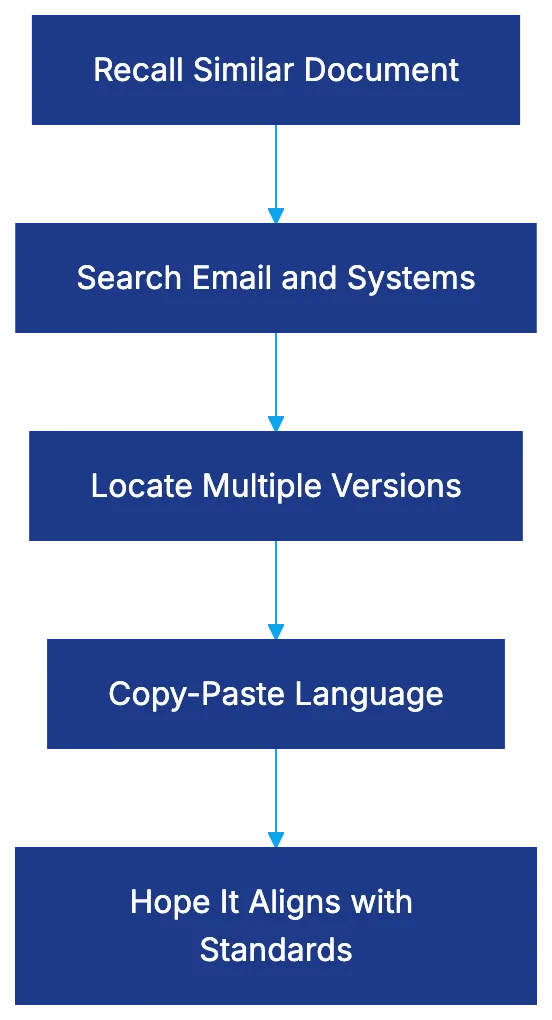
Many legal departments still use “archaeological drafting.” An attorney recalls a similar document, searches through emails and systems, locates multiple versions, copy-pastes language, and hopes it aligns with standards.
This method creates issues:
- Lack of Version Control: Outdated clauses may not reflect new company standards.
- Inefficiency: Legal teams can spend over 6 hours drafting contracts from scratch, which could take less than an hour with existing clauses.
- Compliance Risk: Without a universal library, outdated or non-compliant language may persist.
- Knowledge Loss: Insights often leave with departing attorneys. A clause database prevents this by serving as a single source of approved language.
Traditional Contract Drafting Process:
Key Advantages of Standardized Clause Management
Standardization through software offers these benefits, including improved efficiency and risk management.
-
Consistency: Ensures uniformity across documents. Sales teams rely on standard language for clear expectations and effective audits.
-
Efficient Negotiations: Provide risk-tiered versions for each clause, streamlining negotiations.
-
Systematic Compliance: Updating clauses in the library enacts regulations or risk assessments.
-
Preserving Knowledge: Every refined negotiation feeds back into the clause library.
Transforming Clause Management with AI
AI-Powered Clause Library Workflow:

AI tools convert libraries into interactive assistants, streamlining contract drafting processes.
-
Contextual Suggestion: Platforms recommend appropriate language, improving contract management.
-
AI Clause Extraction: Tools like Kira Systems train models without coding, quickening library builds.
Library speed is notable. A mid-sized company built a 200-clause library from 3,000 contracts in two weeks using AI extraction.
Version Control and Audit Trail Management
Effective software maintains a history of what’s created, edited, and retired, ensuring version control and audit trails.
-
Version Histories: Track clause alterations, ensuring quality and aiding dispute resolution.
-
Approval Workflow: Ensure vetted language joins the library, based on risk levels.
-
Governance and Updates: Prevent proliferation with regular reviews.
Benchmarking and Market Standard Comparison
AI tools benchmark market-standard language, ensuring positions align with industry standards and identifying library gaps.
Seamless Integration into Drafting Workflows
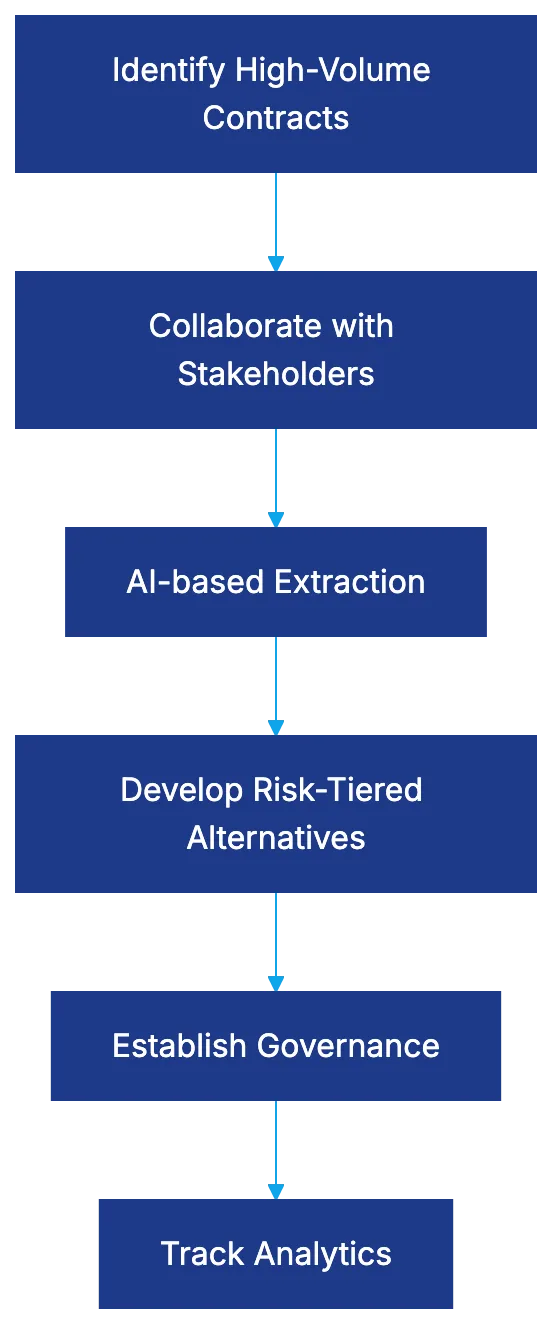
Clause Library Implementation Process:
 For effectiveness, integration with tools is crucial:
-
Word Add-ins and CLM Platforms: Allow seamless clause insertion.
-
API Access: Custom integrations for specialized document tools.
Building Your Clause Library: Implementation Steps
- Identify High-Volume Contracts: Focus on frequently handled contracts.
- Collaborate with Stakeholders: Ensure clauses meet all needs.
- AI-based Extraction: Populate the library and remove obsolete clauses.
- Develop Risk-Tiered Alternatives: Maintain standardization with flexibility.
- Governance for Updates: Regularly review under appointed ownership.
- Track Analytics: Refine and improve accuracy over time.
Leading Platforms in Clause Library Management
Tools like Law Insider, Ironclad, Juro, Legito, and AI-first platforms like Kira Systems and Luminance effectively manage and extract clauses for various needs.
Avoid Common Pitfalls
- Beyond Technology: Ensure strategic setup with curation, governance, and updates.
- Flexibility vs. Standardization: Balance standardization and adaptability.
- Strong Search and Integration: Maintain taxonomy and integration for adoption.
Conclusion
Clause library software is a high-ROI legal tech investment, transforming static repositories into AI-augmented systems. It enhances contract management through efficiency, compliance, consistency, and risk management. Shifting from traditional drafting to proactive knowledge management is essential for capturing and applying crucial legal knowledge.
Frequently Asked Questions
What is a clause library and why is it important?
A clause library is a centralized repository of standardized contract language that helps legal teams draft contracts more efficiently. It is vital because it provides access to approved clauses, ensures consistency, and reduces compliance risks while preserving knowledge even when attorneys leave the firm.
How does AI enhance the effectiveness of a clause library?
AI enhances clause libraries by automating clause extraction and providing contextual suggestions for contract language. This transformation allows legal teams to build comprehensive libraries quickly and improves overall efficiency in contract management processes.
What challenges do traditional contract drafting methods face?
Traditional drafting methods often suffer from inefficiencies such as outdated clauses, lack of version control, and compliance risks. These methods can take excessive time, as they involve searching through multiple documents and potentially losing valuable insights when attorneys depart.
What are the key steps to building an effective clause library?
Building a clause library involves identifying high-volume contracts, collaborating with stakeholders to ensure comprehensive coverage, using AI for clause extraction, and establishing governance and analytics for ongoing improvements. Regular reviews are essential to keep the library updated and relevant.
How can firms ensure compliance with regulatory standards using a clause library?
Firms can maintain compliance by systematically updating clauses in the library to reflect new regulations and conducting regular reviews of the content. This process helps ensure that all language used in contracts aligns with current legal standards and risk assessments.
What are some common pitfalls to avoid when implementing a clause library?
Common pitfalls include neglecting the need for strategic setup and governance, failing to balance standardization with flexibility, and lacking strong search capabilities for easy access. It's crucial to ensure that the library remains relevant and adaptable to emerging legal needs.
Which platforms are recommended for managing clause libraries?
Leading platforms for clause library management include Law Insider, Ironclad, Juro, Legito, and AI-centric tools like Kira Systems and Luminance. These platforms can effectively manage and extract clauses to cater to various organizational needs.
Related Articles

AI in Legal Compliance Management: A Comprehensive Guide
Explore the role of AI in legal compliance, automating tasks and monitoring regulations for law firms and corporate legal departments.

Ironclad's Unique Approach to Contract Management
Explore Ironclad's innovative contract management platform, emphasizing automation, AI, and seamless integrations for legal teams.
Discover Juro: A Modern Approach to Contract Management
Explore how Juro transforms contract management with a browser-native platform, streamlining workflows and enhancing collaboration.